
Casino in Australia: Rules, Payments and Safety Explained
 Available in AU
- Casino Rankings – Why Traditional Rankings Are Unavailable in Australia
- Bonuses and Free Spins – What Australian Players Can Expect
- Pokies and Online Slots – Regulatory Landscape
- Live and Table Games – What Is Allowed in Australia
- Game Providers – Why No Australian‑Licensed Providers Operate Online
- Payments, Banking and Cryptocurrency Options for Australian Players
- Fast Payouts – Realities for Offshore Casinos Serving Australian Players
- Mobile Access, Regional Restrictions and Player Safety
Casino Rankings – Why Traditional Rankings Are Unavailable in Australia
Search for casino rankings in most jurisdictions and you get a list built around one thing: which operators hold a licence from the body that governs that market. Australia doesn’t give you that option, and the reason isn’t an oversight — it’s structural.
There is no single overarching statute or single overarching gambling authority regulating gambling in Australia. Regulation splits between the federal government and the states and territories, each running its own rules, its own regulator, and its own scope of authority. A ranking that says "licensed and approved" needs a single licensing body to point to. Australia doesn’t have one for online casino games, so that sentence can’t be written truthfully here.
Why federal and state authority don’t add up to one ranking system
At the federal level, the Interactive Gambling Act 2001 sets out what’s prohibited nationally — online casino games among them. But the Act is enforced by a regulator, not issued as a licence you can check operators against. There’s no federal register of approved online casinos because the federal government’s role here is restriction, not authorisation.
Before you sign up anywhere, it helps to see how casinos actually compare on licensing, bonus terms, deposit minimums and payout speed — the details that matter once real money is involved.
License: Curacao · Bonus: 100% up to A$500 + 200 free spins, 10x wagering · Payout speed: crypto 30-60 minutes, fiat 1-5 days · Min. deposit: A$10 Curacao-licensed with a substantial welcome package (100% up to A$500 plus 200 free spins, 10x wagering) and a low A$10 minimum deposit, plus fast crypto payouts of 30-60 minutes.
Bonus: up to A$7,500 + 550 free spins across 10 deposits, 50x wagering · Payout speed: crypto under 1 hour, PayID 1-3 business days · Min. deposit: A$20 (A$30 to qualify for the bonus) Offers a large multi-deposit welcome bonus (up to A$7,500 and 550 free spins across 10 deposits) with quick crypto withdrawals under an hour, though the 50x wagering and higher qualifying deposit are worth noting.
License: Curacao eGaming OGL/2024/923/0383 (Antillephone N.V.) · Bonus: up to A$2,000 + 100 free spins across 2 deposits · Min. deposit: A$30 Holds a Curacao eGaming license through Antillephone N.V. and provides a two-deposit welcome offer worth up to A$2,000 plus 100 free spins, with a moderate A$30 minimum deposit.
License: Tobique Gaming Commission · Bonus: up to A$8,000 + 400 free spins across 4 deposits · Payout speed: crypto ~10-15 minutes, fiat 1-5 days · Min. deposit: A$30 Licensed by the Tobique Gaming Commission and stands out for a sizeable four-deposit bonus (up to A$8,000 and 400 free spins), backed by very fast crypto payouts of around 10-15 minutes.
License: Curacao · Bonus: up to A$10,000 multi-stage + 500 free spins · Min. deposit: A$20 (POLi) Curacao-licensed with a multi-stage bonus reaching up to A$10,000 plus 500 free spins, and a low A$20 minimum deposit via POLi.
License: Curacao eGaming (Hollycorn N.V., since 2017) · Bonus: 225% up to A$1,540 + 600 free spins across 4 deposits, 20x wagering · Min. deposit: A$20-30 (depends on the offer) An established Curacao eGaming operator (Hollycorn N.V., licensed since 2017) offering a generous four-deposit bonus of 225% up to A$1,540 plus 600 free spins with manageable 20x wagering.
License: Curacao Gaming Control Board OGL/2023/176/0095 (Hollycorn N.V.) · Bonus: up to A$5,000 + 300 free spins across 4 deposits Licensed under the Curacao Gaming Control Board via Hollycorn N.V., with a four-deposit welcome bonus totaling up to A$5,000 and 300 free spins.
License: Curacao eGaming (Roby Games Ltd) · Bonus: 100% up to A$750 + 200 free spins Operates under a Curacao eGaming license held by Roby Games Ltd, offering a straightforward welcome bonus of 100% up to A$750 plus 200 free spins.
Bonus: 100% up to A$750 + 200 free spins, 35x wagering · Payout speed: crypto 30-120 minutes, fiat 24-72 hours · Min. deposit: A$30 Provides a 100% up to A$750 bonus with 200 free spins and 35x wagering, alongside relatively quick payout times for both crypto and fiat methods.
License: Curacao eGaming OGL/2023/174/0082 (Dama N.V.) · Bonus: up to A$10,000 + 500 free spins across 4 deposits · Min. deposit: A$15 Licensed under Curacao eGaming through Dama N.V., notable for a large four-deposit bonus of up to A$10,000 and 500 free spins combined with a low A$15 minimum deposit.
At the state and territory level, each jurisdiction runs its own gambling regulator, with its own remit. These bodies license land-based venues, wagering products, and other gambling activities permitted in their territory. None of them issues licences for online casino games, because none of them is legally able to. The activity itself falls outside what any Australian regulator is set up to authorise.
The closest thing to a national player in online gambling licensing is the Northern Territory Racing Commission. It licenses most of the country’s national online bookmakers, largely because operators based there benefit from a lower tax rate than they’d face elsewhere. That’s made the NTRC a de-facto reference point for online wagering — but its licensing covers sports and racing betting, not online casino games. It doesn’t fill the gap that a casino ranking would need filled.
What this means for any list you’re shown
A ranking built on "licensed by an Australian authority" can’t exist for online casino games, because no Australian authority licenses them. Any list claiming otherwise is either describing sports betting operators under a different name, or describing offshore licensing as if it were domestic — two different things worth telling apart.
There is no public register in Australia to verify an operator’s licence for online casino games, so you cannot perform a standard licence check.
This also explains why you won’t find a public register to check an operator against. Other markets solve the ranking problem by pointing to that register: search the licence number, confirm it’s current, move on. Australia has no equivalent register for online casino games, at federal or state level, because there’s no licence to register in the first place.
What a ranking can reasonably tell you instead
None of this means information about operators is unavailable — it means the information has to be framed differently than "government-approved" or "top-rated by regulators." What can actually be assessed and compared:
- Which offshore jurisdiction issued the operating licence — the regulator’s name and location are verifiable facts about the operator, separate from any claim about Australian approval.
- How the operator’s terms handle Australian players specifically — whether the site acknowledges restrictions like the ban on credit card and cryptocurrency deposits, rather than ignoring the local legal context entirely.
- What the operator’s history shows — whether it has faced enforcement action, been named in ACMA blocking notices, or continued operating without disruption.
None of these substitute for a licence check, because the check that matters — confirmation against an Australian regulator — has no register to run it against. That’s the actual state of the market, not a gap in reporting.
The following sections work through what is and isn’t permitted for Australian players in more specific terms — bonuses, game types, payments, and payout handling — each shaped by the same fragmented regulatory picture described here.
Bonuses and Free Spins – What Australian Players Can Expect
Search for bonuses and free spins tied to an Australian online casino, and you run into the same wall that surrounds the rest of this market: there is no licensed local operator to award them. Every real-money casino bonus an Australian player might encounter comes from an offshore-licensed site, not from anything authorised inside the country.
That distinction matters more than it first appears. The Interactive Gambling Act 2001 makes it illegal to offer online casino gambling to Australian residents, and slots, poker, blackjack and roulette are named specifically among the prohibited game types. No domestic licence exists for any of it, which means no local operator can legally structure a bonus, a wagering requirement, or a free-spin promotion in the first place. There is nothing to compare, because there is nothing on offer domestically.
Why offshore promotions exist at all
The law is written to target operators, not players. An individual in Australia who signs up with an offshore-licensed casino and accepts a deposit match or a batch of free spins is not committing an offence. The offence, if there is one, sits with whoever is running the casino from outside Australian jurisdiction without the right to solicit local business. This is the same asymmetry that shapes the rest of the market: the law can reach into advertising and payment rails, but it cannot make the offer to an individual player illegal after the fact.
Practically, this means the bonuses circulating among Australian players are drafted under whatever licensing regime the offshore operator answers to — a foreign framework, not an Australian one. The terms, the wagering requirements, and the eligibility rules are set by that jurisdiction’s standards, not by anything ACMA or a state regulator has reviewed or approved.
What this means for reading the terms
Because no Australian authority vets these offers, the burden of reading the fine print sits entirely with the player. A few points follow directly from the legal gap rather than from any specific promotion:
- No local recourse for bonus disputes. If a wagering requirement is disputed, there is no Australian regulator to appeal to, because the operator was never licensed here.
- No standardised disclosure rules apply. Requirements to show wagering conditions clearly before a bonus is accepted come from the offshore licence, not from Australian consumer protection law.
- No verification of the operator’s legitimacy through an Australian register. There is no public list of approved casino operators to cross-check a bonus offer against, because the activity itself isn’t licensed domestically.
None of this makes the promotions inherently fraudulent — it means the usual local safety net, the one that exists for licensed sports betting or lotteries, simply isn’t there for casino-style bonuses.
How this differs from the ranking problem
The absence of official rankings, covered elsewhere, comes from the lack of a single regulator with authority to certify operators. The bonus situation is a downstream consequence of the same gap, but it’s a distinct issue: even if a ranking existed, it couldn’t certify that a bonus’s terms meet an Australian standard, because no such standard has been written into law for online casino promotions. What you’re evaluating when you read a free-spin offer is not compliance with an Australian rule — it’s the offshore licence’s own terms, applied to a player the operator wasn’t strictly authorised to solicit in the first place.
This is also why credit cards and cryptocurrency deposits sit outside the bonus conversation entirely — they’re excluded by separate rules covered under payments — while a bonus itself, structured as free spins or deposit matches, isn’t blocked by the IGA in the same direct way an online pokie session is. The legal exposure sits with the operator offering the game, not with the promotional mechanism wrapped around it.
All casino bonuses available to Australian players are issued by offshore licences, meaning the terms are set by foreign regulators rather than any Australian authority.
Reading a bonus offer aimed at Australian players, then, is less about spotting a scam and more about recognising that no domestic authority has looked at these terms before they reached you.
Pokies and Online Slots – Regulatory Landscape
Walk into a licensed venue in Australia and you can legally play the pokies — the machines are regulated by the state or territory where the venue operates, and each jurisdiction sets its own rules for how they run. Try to find the same machine as a real-money game on a website, and the legal picture changes completely. Online pokies fall under a different law entirely, and that law treats them as prohibited, full stop.
The Interactive Gambling Act 2001 is the federal legislation that draws this line. It specifically prohibits online casino style games — slots, poker, blackjack, and roulette are named in the legislation — from being offered to people in Australia. It doesn’t matter whether the operator calls the game a pokie, a slot, or anything else; if it’s a casino-style game delivered over the internet for real money, it falls inside the prohibition.

Why the same game is legal in one form and not the other
The distinction isn’t about the mechanics of the machine. A pokie’s reels, symbols, and random outcome generation don’t change whether you’re standing in front of it or looking at it on a screen. What changes is the delivery method. State and territory regulators license and supervise physical venues — they can inspect the machines, audit the operator, and enforce standards because the venue exists inside their jurisdiction. An online slot offered from a website has no equivalent point of contact. There’s no venue to inspect and, more fundamentally, no licence that could legally be issued for it, because the Interactive Gambling Act 2001 removes that option at the federal level for any operator wanting to serve Australian residents online.
This is why there are no domestically licensed real-money online casino operators available to Australian players. It’s not that no one has applied, or that the standards are simply stricter online — it is not possible to obtain a licence to operate an online casino domestically at all. The category doesn’t exist on the Australian regulatory map. Offering one is illegal for the operator, regardless of who they are or where they’re based.
What this means in practice
Australians can and do access online slots, but every one of those platforms is licensed somewhere else — typically an offshore jurisdiction — because no local licensing pathway exists. The law’s prohibition is aimed at the operator offering the game to Australian residents, not at the individual playing it, which is why offshore-licensed sites remain reachable even though they’re operating outside what Australian law permits them to do.
Illegal Offering
Offering online casino games to Australian residents breaches the Interactive Gambling Act 2001 and can result in enforcement action.
Enforcement of this prohibition sits with the Australian Communications and Media Authority. ACMA is the federal regulator responsible for enforcing the Interactive Gambling Act 2001, and its role with online slots specifically is to identify offending services and act against them — not to license or approve any operator to offer the games legally, since that option doesn’t exist for this category.
Slots versus other casino games
It’s worth being precise about scope here, because the prohibition doesn’t distinguish slots from other casino-style formats in the way some players assume. The same section of the Interactive Gambling Act 2001 that names slots also names poker, blackjack, and roulette. There’s no separate, lighter rule for reel-based games because they resemble a familiar pub or club machine. Legally, an online pokie is treated the same way as any other online casino game — prohibited for an operator to offer, with no domestic licence available to change that status.

Where the picture does shift is with live dealer formats and certain table game structures, which raise separate questions about in-play betting rules and are covered on their own terms elsewhere. For pokies and standard online slots specifically, the regulatory position is not ambiguous: the format sits squarely inside the prohibition set by the Interactive Gambling Act 2001, enforced federally by ACMA, with no pathway for an Australian licence to authorise it.
Live and Table Games – What Is Allowed in Australia
The Interactive Gambling Act 2001 draws a line that surprises a lot of people the first time they read it closely. It doesn’t ban gambling by format alone — it bans it by mechanism. Live blackjack, live roulette, and live poker offered through a real-money online casino fall under the same prohibition as slots. The Act names them directly: online casino-style games, including slots, poker, blackjack, and roulette, are prohibited under federal law, regardless of whether a physical dealer is running the table on a video feed or a random number generator is running it in software.
This matters because "live" is sometimes assumed to mean "different rules apply." It doesn’t. A live dealer streaming from a studio is still an online casino game the moment real money changes hands through it. The Act doesn’t grant an exemption for human dealers, and no state or territory regulator issues a licence that would make live-dealer blackjack or roulette legal to offer to an Australian resident. If a platform is marketing a live table game to Australian players, that platform is operating outside the licensing framework this country recognises — the same position slots and other casino-style games occupy.
In-play betting is a separate prohibition
Where things get genuinely confusing is in-play betting — placing a wager on a sporting event after it has started. This is banned federally, but for a different reason than casino games are banned. In-play betting sits under the sports wagering provisions of the Interactive Gambling Act 2001, not the casino-games provisions. The practical effect is the same — it’s illegal to offer it online to someone sitting in Australia — but the legal basis and the products involved are entirely different from a blackjack table or a slot reel.
Live Games
Live‑dealer blackjack, roulette and poker are also prohibited for Australian players under the same federal casino‑games provisions.
There’s a narrow carve-out worth knowing about: live betting placed by phone is legal. If you call a licensed wagering operator and place an in-play bet verbally, that transaction is treated differently under the Act than the same bet placed through a website or app in real time. It’s a distinction that exists because the law was written before continuous online in-play markets were common, and it hasn’t been rewritten to close that gap. It doesn’t extend to online casino games in any form — there’s no phone-based version of live-dealer roulette that becomes legal because a call centre is involved.
What this means in practice
| Format | Legal status | Basis |
|---|---|---|
| Live-dealer blackjack, roulette, poker (online) | Prohibited | Falls under casino-games provisions of the IGA 2001 |
| In-play sports betting via website or app | Prohibited | Falls under sports-wagering provisions of the IGA 2001 |
| In-play sports betting by phone | Legal | Specific phone-betting exception |
| Pre-match online sports betting | Legal | Licensed under state/territory frameworks |
Two things stay constant across every row in that table. First, the law targets the operator, not the player — an Australian resident placing a bet or sitting at an offshore live table isn’t committing an offence, even where the platform offering the game is acting unlawfully by Australian standards. Second, no state or territory gambling regulator — not Liquor & Gaming NSW, not the Victorian Gambling and Casino Control Commission, not the Northern Territory Racing Commission — issues a licence covering live or table casino games for online, real-money play. Their authority extends to land-based venues and licensed wagering products, not to interactive casino tables.
If a site advertises a live-dealer table as something distinct from its slots catalogue, or implies that table games occupy a different legal category, that framing doesn’t hold up against the Act’s actual text. The prohibition covers the category of casino-style games as a whole. What separates legal from illegal in this space isn’t the dealer, the graphics, or the game type — it’s whether the product is a licensed sports-wagering bet or an online casino-style game, and under current federal law, only the former has a path to a domestic licence.

Game Providers – Why No Australian‑Licensed Providers Operate Online
Every real-money pokie, blackjack table, or roulette wheel you find running on a casino site is built and maintained by a game provider — a studio that designs the software, sets up the random number generator, and licenses that software to operators. In Australia, none of these studios can hold a domestic licence to supply real-money online casino games, because no such licence exists to hold.
The Interactive Gambling Act 2001 makes it illegal to offer online casino gambling from within Australia. That prohibition doesn’t stop at operators. A game studio based in Australia that built a real-money pokie or live roulette engine and supplied it to a site accessible by Australian residents would be supplying a service the law doesn’t permit anyone to provide domestically. There’s no application process, no fee schedule, no compliance pathway that ends in an Australian real-money casino game licence — because the activity itself sits outside what any Australian regulator is authorised to approve.

Why the licensing gap exists
Australia doesn’t have one national gambling regulator that could theoretically create such a licence even if policy shifted. Each state and territory runs its own regulator, and each of those bodies is built around the gambling forms permitted in its jurisdiction — wagering, lotteries, land-based casino floors under strict local oversight. None of them issue licences for online real-money casino content, because the underlying activity is prohibited at the federal level regardless of which state a studio might be based in.
The Northern Territory Racing Commission comes closest to functioning as a de-facto national regulator for interactive gambling, since it licenses most of the online bookmakers operating across the country and does so under a lower tax structure than other states offer. But that licensing role covers sports and racing wagering operators — not online casino game supply. The NTRC’s remit doesn’t extend to authorising slot studios or live dealer providers, because that category of product remains outside legal online gambling in Australia altogether.

Where the games actually come from
The pokies, table games, and live dealer streams that Australians access on offshore sites are built by studios licensed elsewhere — jurisdictions such as Malta or Curaçao, where real-money online casino supply is a licensed, regulated activity. Names like Pragmatic Play, Microgaming, NetEnt, and Evolution Gaming operate under those foreign licences, not Australian ones. Their games reach Australian players because the operators hosting them are licensed offshore and accept players from markets where online casino gambling isn’t locally authorised — a legal position built entirely around the fact that Australian law targets operators and suppliers, not the individual player choosing to use an offshore-licensed site.
This is why you won’t find an "Australian-licensed" badge next to a slot title or a live blackjack table anywhere in this market. The badge would be false. Any game running with a real-money option available to an Australian player was built and certified under a foreign regulator’s rules, not a local one.

What this means when you’re comparing providers
Because there’s no domestic licensing regime for game supply, checking a provider’s "Australian licence" is not a step you can take — there’s nothing to check. What you can look at is which offshore jurisdiction actually licensed the studio and the operator running the game, since that determines what technical standards the random number generator and payout logic were tested against before the game went live. That distinction sits separately from whether the operator hosting the games handles deposits and withdrawals in a way that matches Australian banking restrictions — a separate question covered elsewhere.
The absence of Australian-licensed providers isn’t a gap waiting to be filled by a future domestic studio. It’s a direct consequence of the activity itself being outside what any Australian regulator, state or federal, is permitted to license. Until that changes at the legislative level, every real-money casino game reaching an Australian screen will have been built under someone else’s rules.

Payments, Banking and Cryptocurrency Options for Australian Players
Credit cards and cryptocurrencies are prohibited for gambling deposits in Australia. That single rule shapes everything else in this section, because it applies regardless of where the operator is licensed. An offshore casino accepting Australian players cannot legally take a credit card payment or a Bitcoin or Ethereum deposit from someone gambling from an Australian address. The prohibition sits on the deposit itself, not on the operator’s location.
This is worth separating from the licensing question covered elsewhere. Whether or not an operator holds a licence anywhere in the world, the payment method used to fund a gambling account is restricted at the point of transaction. A casino licensed in Curaçao, Malta, or Kahnawake does not gain permission to accept a credit card or crypto deposit from an Australian player simply because its home regulator allows it. The restriction travels with the player’s location, not the operator’s paperwork.
Why no single regulator enforces this on payments
Australia has no single overarching gambling authority. The Australian Communications and Media Authority enforces the Interactive Gambling Act 2001 at the federal level, but it does not process payments, audit bank accounts, or certify which payment rails a casino uses. Each state and territory runs its own regulator on top of that federal layer. The Northern Territory Racing Commission licenses most national online bookmakers because of its lower tax structure, making it the de facto regulator for online wagering — but its remit covers sports betting operators it licenses domestically, not offshore casino payment processing.

The Victorian Gambling and Casino Control Commission monitors wagering service providers, including ones based in other states, for compliance with the National Consumer Protection Framework. Liquor & Gaming NSW does similar work in its own jurisdiction. Both bodies have limited power over offshore online casinos. Neither can inspect the banking infrastructure of a company incorporated outside Australia, and neither issues guidance on what payment method a foreign-licensed casino should use for an Australian customer. Land-based casinos answer to state regulators and law enforcement directly; that oversight does not extend to a website hosted overseas.
The practical result: no Australian regulator certifies, blesses, or blacklists specific payment methods for offshore casino platforms. The credit card and cryptocurrency prohibition comes from the Interactive Gambling Act framework itself, enforced federally, while the fragmented state and territory system has no equivalent authority to police how an offshore operator moves money.
What this means for how you fund an account
Since credit cards and digital currencies are off the table, offshore casinos serving Australian players typically rely on bank transfers, PayID, and e-wallet services that route through standard banking channels rather than card networks or blockchain. PayID has become a common method precisely because it moves through the same domestic payment system used for everyday transfers, sidestepping the credit card restriction entirely. Debit cards linked to a transaction account, rather than a line of credit, generally fall outside the credit card ban because the funds are the player’s own money rather than borrowed funds.
None of this is verified or endorsed by an Australian regulator. There is no register you can check to confirm that a given payment processor is "approved" for gambling use, because no such approval process exists for offshore operators. The absence of a credit card or crypto option on a casino’s deposit page is not a courtesy — it is the operator complying with a restriction that applies to the transaction regardless of which country licensed the platform.

Where the rule stops applying
The credit card and cryptocurrency prohibition applies to gambling deposits specifically. It does not extend to how you receive money elsewhere, and it says nothing about withdrawal speed, identity checks before payout, or how quickly funds clear once a withdrawal is approved — those are separate mechanics tied to verification processes rather than payment method restrictions, and they work differently enough that they deserve their own explanation rather than being folded into the deposit rules here.
Fast Payouts – Realities for Offshore Casinos Serving Australian Players
A withdrawal request has to travel through a system before it becomes money in an account, and that system was not built with any Australian regulator’s rules attached to it. There is no domestically licensed real-money online casino operator for Australian players — so the "fast payout" you read about on a casino review site is a promise made by an offshore operator, under offshore rules, with no local body checking whether the promise is kept.
That distinction matters more than it looks. It is not illegal for an individual Australian to play at an offshore-licensed casino; the Interactive Gambling Act 2001 targets the operators offering the service, not the person placing the bet. But that same law makes it illegal to offer online casino gambling from within Australia, and there is no path to obtain a domestic licence for it. The result is a structural gap: every online casino a player in Australia uses sits outside the jurisdiction that would otherwise set withdrawal timeframes, dispute processes, or penalties for delay. Land-based casinos are a different animal entirely — those are licensed and monitored by state government regulators and law enforcement agencies, with physical premises, audited cash handling, and inspectors who can walk in the door. None of that applies to a website processing a withdrawal from a server offshore.

What actually slows a payout down
Two things determine how quickly a withdrawal clears, and neither of them is under Australian jurisdiction:
- Identity verification. Before releasing funds, an offshore operator will require proof of identity — matching the name on the account to a government-issued document, and often to the payment method used for deposits. This is standard KYC practice across the industry, not an Australian requirement, but it is the single biggest variable in how long a withdrawal takes. An account verified in advance moves through this step once; an account left unverified until the first withdrawal request stalls at exactly the point most players expect their money to move.
- The operator’s own processing rules. Because there’s no Australian regulator setting withdrawal timeframes for these platforms, each operator sets its own — reviewed against nothing but its own licence conditions, issued by whichever offshore authority granted it (Curacao Gaming Control Board and Kahnawake Gaming Commission are common examples). Two casinos advertising “fast withdrawals” can mean genuinely different things by it, and there’s no Australian document you can check to see whose definition applies.
Why there’s no local recourse
If a withdrawal is delayed, denied, or disputed, an Australian player has no domestic regulator to escalate it to. ACMA enforces the Interactive Gambling Act 2001 against operators illegally targeting Australians, and it can block sites or refer matters to the Australian Federal Police — but its role is to act against unlawful operators, not to mediate individual payout disputes or recover funds on a player’s behalf. State-based bodies like Liquor & Gaming NSW or the Victorian Gambling and Casino Control Commission have no reach into an offshore operator’s payment processing either. Whatever complaint procedure exists sits entirely with the operator itself, under the terms it wrote.
What this means in practice
Before assuming a payout will be fast, it’s worth checking what actually controls the timeline:
- Verification status — has identity documentation already been submitted and approved, or will it be requested for the first time at withdrawal?
- Payment method match — does the withdrawal method align with the deposit method, since mismatches are a common reason for manual review?
- Operator-stated processing window — what does the operator itself claim, understanding that this figure comes from its own terms and not from any Australian standard?

None of these checks replace a licence, because there isn’t one to check against. They’re simply the variables that determine whether a withdrawal clears without friction — and, absent a domestic regulator, they’re the only variables a player actually controls.
Mobile Access, Regional Restrictions and Player Safety
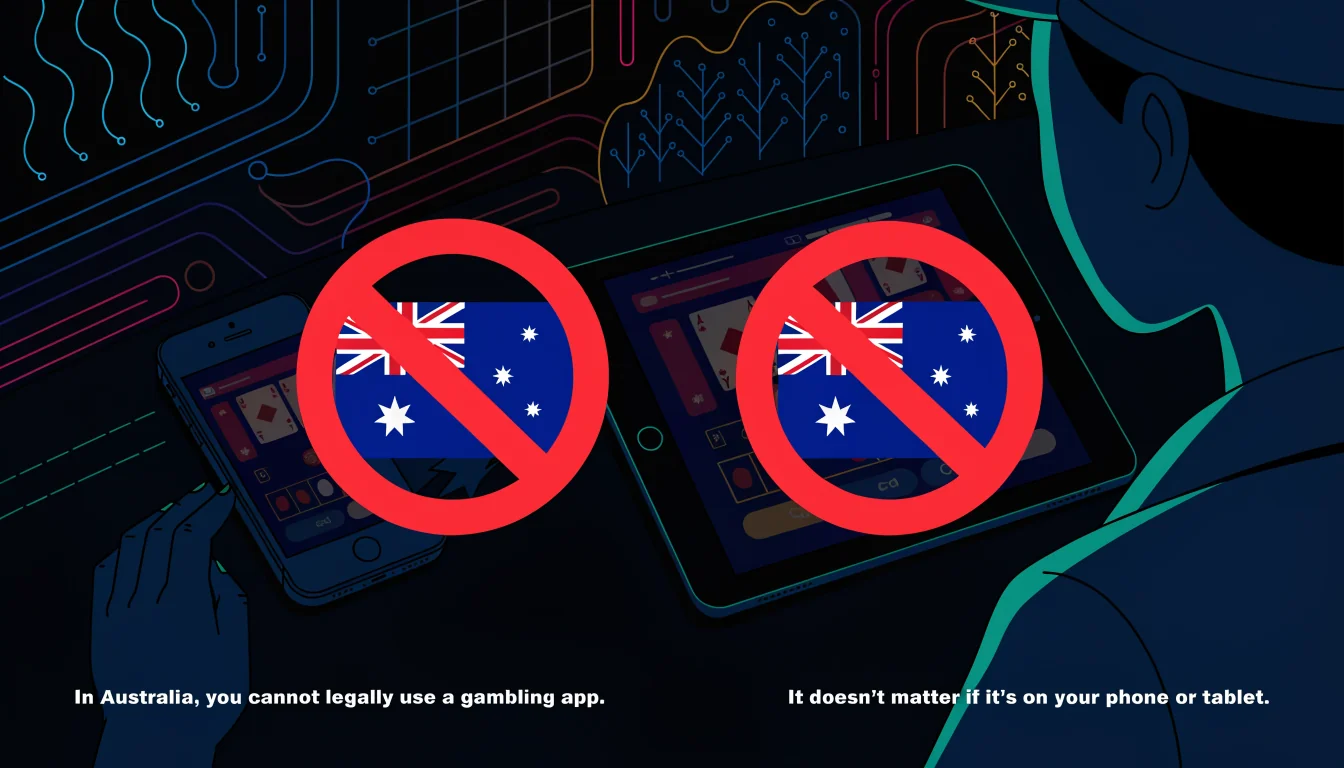
A phone or tablet does not change what is legal. If an online casino game is prohibited under the Interactive Gambling Act 2001 on a desktop browser, it is equally prohibited when accessed through a mobile browser or an app. There is no separate mobile carve-out in the law, and no state or territory issues a licence that makes a mobile casino app lawful to operate from within Australia. Mobile access simply changes where you tap, not what the underlying legal status of the product is.
This matters because mobile is where most enforcement friction actually shows up. ACMA does not regulate gambling by device type — it regulates by blocking access at the network level, regardless of whether the request comes from a phone, a laptop, or a smart TV browser.
How blocking works in practice
Since November 2019, ACMA has had the power to order Australian internet service providers to block access to offshore gambling sites operating illegally. This applies to any interactive gambling service offering products not permitted under Australian law — online casinos, online pokies, and in-play sports betting all fall into that category. The blocking is done at the ISP level, which means it affects access from any connected device on that network, mobile included.
The scale of this effort has been reported differently depending on the source and the date of reporting:
- One account states that ACMA had blocked access to 975 illegal gambling and affiliate websites since November 2019, as of a 2024 publication.
- A later figure, cited as of August 2025, puts the number at 1,296 blocked sites and affiliates since 2019, with over 220 illegal services having voluntarily exited the Australian market.
These are not two contradictory claims about the same fixed number — they are separate snapshots taken at different points in an ongoing enforcement process, so the higher figure reflects a later count rather than a correction of the earlier one.
Separately, one industry source (theiaga.org) has reported that more than 100 illegal gambling services, including online casinos, exited the Australian market since ACMA began enforcing these rules in 2017. Another source (boomaff.com) puts the figure at over 220 illegal services having ceased operations due to ACMA’s enforcement actions. Treat these as reported figures from specific sources rather than as an agreed industry benchmark — the underlying counts and time frames differ between them.
What this means for regional access
Because blocking happens at the ISP level rather than through a licensing register, there is no map of "approved regions" within Australia where mobile casino access is permitted and others where it is not. The restriction is national, tied to the operator’s legal status rather than to where the player is physically located within the country. A blocked site stays blocked whether you are connecting from a capital city or a regional area — the block follows the ISP account, not the postcode.
This also means mobile apps distributed outside official app stores, or accessed via direct APK downloads advertised on blocked sites, sit in the same legal position as the website version. An app wrapper does not create a workaround to the underlying prohibition.
Player safety measures tied to this enforcement
ACMA’s blocking regime is only one layer. It cannot recover money or settle a dispute you have with an offshore operator directly — its role is limited to investigating and blocking the service itself, referring matters to the Australian Federal Police, notifying border protection agencies about the operators involved, and liaising with regulators in other countries. None of that produces a refund or resolves a withdrawal complaint on your behalf.
For a mobile-first player, the practical safety takeaway is that the device you use does not add or remove any protection. The legal status of the operator, not the platform, determines whether ACMA’s enforcement tools apply — and those tools are aimed at making the service inaccessible, not at compensating individual users for losses incurred before a block takes effect.
Written by the editors at Pokies Live Guide.