
Online Pokies E-Wallet Australia: Regulation and Cashless Play
 Available in AU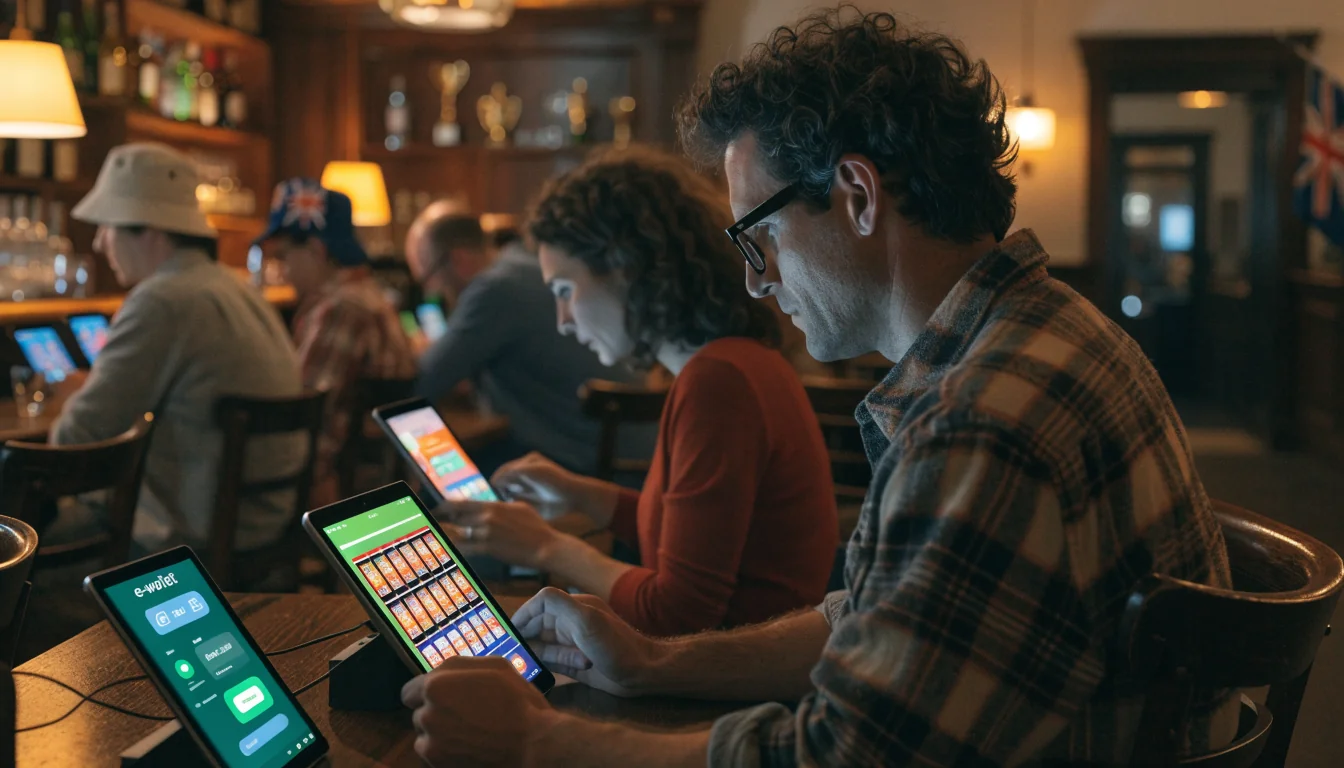
Understanding Pokies in Australia: Market Size, Regulation, and the Move to Cashless e‑Wallet Gaming
Pokies are what Australians call electronic gaming machines — the term used interchangeably across pubs, clubs, and casinos from Perth to Cairns. They run in every state, plus the Australian Capital Territory and the Northern Territory, which makes them one of the few forms of gambling with genuinely uniform national reach, even though each jurisdiction regulates them separately. If you have ever walked into a suburban RSL club or a local hotel bar and heard the layered chime of a bank of machines, you have already seen the backbone of the Australian gambling industry.
Before looking at how e‑wallets fit into this picture, it helps to understand what pokies actually are, how large the market is, who regulates it, and why the shift to cashless machines is happening now rather than five years ago.
What Counts as a Pokie
A pokie is a standalone electronic gaming machine that accepts a wager, runs a randomised outcome, and pays out according to a fixed set of rules programmed into its software. In Australia these machines are typically found in three types of venues:
- Pubs and hotels, where a small number of machines sit in a dedicated gaming room.
- Clubs — RSLs, sporting clubs, workers’ clubs — which often hold the largest concentrations of machines outside casinos.
- Licensed casinos, where pokies sit alongside table games and, in some states, sports betting terminals.
If you’re planning to fund your play through an e-wallet or crypto in 2026, payout speed, deposit minimums, and welcome bonus terms matter more than flashy claims — here’s what each option actually offers on paper.
License: Curacao · Bonus: 100% up to A$500 + 200 free spins, 10x wagering · Payout speed: crypto 30-60 minutes, fiat 1-5 days · Min. deposit: A$10 Curacao-licensed with a solid welcome package of a 100% match plus 200 free spins at 10x wagering, and fast crypto payouts within an hour, though fiat withdrawals take a few days. A low A$10 minimum deposit makes it easy to get started.
Bonus: up to A$7,500 + 550 free spins across 10 deposits, 50x wagering · Payout speed: crypto under 1 hour, PayID 1-3 business days · Min. deposit: A$20 (A$30 to qualify for the bonus) Offers one of the larger multi-deposit bonus structures, spread across ten deposits with a generous spins package, though the 50x wagering requirement is on the steeper side. Crypto payouts land in under an hour, while PayID withdrawals take a few business days.
License: Curacao eGaming OGL/2024/923/0383 (Antillephone N.V.) · Bonus: up to A$2,000 + 100 free spins across 2 deposits · Min. deposit: A$30 Holds a Curacao eGaming license under Antillephone N.V. and runs a two-deposit welcome bonus with free spins, backed by a moderate A$30 minimum deposit.
License: Tobique Gaming Commission · Bonus: up to A$8,000 + 400 free spins across 4 deposits · Payout speed: crypto ~10-15 minutes, fiat 1-5 days · Min. deposit: A$30 Licensed by the Tobique Gaming Commission, this operator backs a sizeable four-deposit bonus with fast crypto payouts in around 10-15 minutes, while fiat withdrawals take up to five days.
License: Curacao · Bonus: up to A$10,000 multi-stage + 500 free spins · Min. deposit: A$20 (POLi) Curacao-licensed with a large multi-stage bonus and a substantial free spins allowance, and it accepts POLi deposits starting from A$20, giving Australian players a familiar local payment option.
License: Curacao eGaming (Hollycorn N.V., since 2017) · Bonus: 225% up to A$1,540 + 600 free spins across 4 deposits, 20x wagering · Min. deposit: A$20-30 (depends on the offer) Licensed through Curacao eGaming under Hollycorn N.V. with an operating history since 2017, it pairs a strong percentage match bonus with a relatively low 20x wagering requirement and flexible deposit minimums.
License: Curacao Gaming Control Board OGL/2023/176/0095 (Hollycorn N.V.) · Bonus: up to A$5,000 + 300 free spins across 4 deposits Holds a Curacao Gaming Control Board license via Hollycorn N.V. and spreads a solid welcome bonus with free spins across four deposits.
License: Curacao eGaming (Roby Games Ltd) · Bonus: 100% up to A$750 + 200 free spins Licensed under Curacao eGaming through Roby Games Ltd, offering a straightforward 100% match bonus with 200 free spins for newcomers.
Bonus: 100% up to A$750 + 200 free spins, 35x wagering · Payout speed: crypto 30-120 minutes, fiat 24-72 hours · Min. deposit: A$30 Provides a 100% match bonus with 200 free spins at 35x wagering, plus quick crypto payouts within a couple of hours and fiat processed within a few days, all accessible from a A$30 minimum deposit.
License: Curacao eGaming OGL/2023/174/0082 (Dama N.V.) · Bonus: up to A$10,000 + 500 free spins across 4 deposits · Min. deposit: A$15 Licensed under Curacao eGaming via Dama N.V., it stands out for a very low A$15 minimum deposit alongside a large bonus spread across four deposits with a substantial free spins offer.
This is a different category from online casino slots. A pokie in a licensed Australian venue is a physical machine operating under a state or territory gaming licence. An online slot offered by an offshore website is a different product entirely, governed by different — and in most respects far stricter — rules, which the later part of this article addresses directly.
The Size of the Market
The scale of pokie gambling in Australia is not a marginal detail — it is the defining fact of the market. In the 2020–2021 financial year, Australians placed bets worth almost AUD 150 billion on electronic gaming machines. Total player losses for that same year came to about AUD 12 billion, which works out to AUD 608 in per‑capita losses across the population.
Those numbers describe turnover and loss during a single financial year affected by pandemic-related venue closures, so they should be read as a snapshot of that period rather than a fixed annual figure. A separate figure, reported by complyadvantage.com, states that pokies generated AUD 191.2 billion in gambling turnover in 2023. The two figures come from different sources, cover different years, and likely measure turnover using different methodologies, so they should not be treated as directly comparable data points tracking a single trend — they are separate snapshots reported by separate sources.
What both figures agree on is direction: pokies are not a small side business within Australian gambling. They are the largest single contributor to gambling turnover in the country, dwarfing sports betting, lotteries, and casino table games combined in most state-level breakdowns.
How Much of the World’s Pokies Are in Australia
One statistic gets cited constantly in discussions of Australian gambling culture, and it deserves a direct explanation rather than a repeated assumption. One source states that Australia accounts for 3% of the world’s pub and club poker machines. A different source puts the figure at about 18% of the world’s poker machines globally.
The two world‑share figures (3 % and 18 %) are not directly comparable; they are based on different definitions and geographic scopes, so both should be presented with this caveat.
These two numbers are not a rounding difference — they are an order of magnitude apart, and no attempt is made here to decide which one is correct. The discrepancy likely comes down to definitions: whether "poker machines" is counted narrowly (pub and club machines only, excluding casino floors) or broadly (all EGMs including casino-based machines), and whether the comparison base is "developed nations" or "the entire world" including regions with minimal EGM regulation or reporting. What matters for you as a reader is knowing that both figures circulate, that they measure different things, and that neither should be repeated as a settled fact without noting the other.
What is not in dispute is that Australia has one of the highest concentrations of gaming machines per capita among developed nations, and that pokies are embedded in everyday social infrastructure — pubs and clubs — in a way that has few parallels elsewhere.
Who Regulates Pokies in Australia
Gambling regulation in Australia is split between the Commonwealth and the states/territories, and pokies sit mostly under state and territory control rather than federal law.


State and territory gaming regulators — including the Office of Liquor and Gaming Regulation in Queensland and the ACT Gambling and Racing Commission in the Australian Capital Territory — issue venue licences, set machine caps, and enforce local rules on operating hours, machine placement, and venue conduct. Each jurisdiction runs its own licensing regime, which is why pokie rules differ from state to state even though the machines themselves look and function almost identically.
Running alongside this state-based licensing structure is a federal layer focused specifically on financial crime: AUSTRAC, Australia’s financial intelligence and anti-money-laundering regulator. AUSTRAC’s remit does not concern game fairness or venue licensing — it concerns the money moving through the machines, and it is where the connection between pokies and financial crime becomes a formal regulatory concern rather than a background risk.
Why Pokies Attract AUSTRAC’s Attention
Pokies handle enormous volumes of cash. A machine that accepts banknotes, dispenses payout tickets, and requires no account, no bank transfer, and historically no identification, is structurally well suited to moving money anonymously — which is precisely the profile that concerns a financial intelligence regulator.
AUSTRAC’s obligations scale with the size of the operation:
- Venues with up to 15 pokies must register with AUSTRAC, keep identification records for relevant transactions, and submit suspicious matter reports when required.
- Venues with more than 15 pokies carry a heavier compliance load: they must appoint a compliance officer, conduct formal risk assessments, implement AML/CFT programs, perform customer due diligence, and report any cash transaction over AUD 10,000.
The tiered structure reflects a simple logic: larger venues process more cash, more often, and with more opportunity for that cash to be structured or disguised, so the compliance burden increases in step with the machine count. A single-machine country pub and a 200-machine metropolitan club are not held to the same standard, and that difference is written directly into how registration and reporting obligations are set.
The Shift Toward Cashless, Account‑Based Machines
The direction regulators want the industry to move in is clear, even where the timeline and scope differ by state. The 2022 NSW Islington Report recommended making all NSW pokies cashless by the end of 2028 — a single state-level recommendation, not a national mandate, and worth treating as exactly that: one report’s proposed target for one jurisdiction, not a commitment that has been legislated across the country.
The logic behind the push is one that shows up consistently in regulatory and industry commentary: a cash-based machine leaves almost no trail. Someone can insert banknotes, play briefly, and cash out, and nothing about that transaction identifies who they are or where the money came from. A cashless, account-based machine changes that structurally. Every deposit, every spin, and every withdrawal is tied to a registered account rather than a stack of banknotes fed into a slot.
Machines that accept and dispense physical cash, leaving no electronic trail of individual player activity.
Machines linked to an electronic wallet or account, providing full traceability of deposits, play and withdrawals.
Machines that allow both cash insertion and e‑wallet loading, offering flexibility while still improving traceability for electronic transactions.
According to research from facctum.com, adoption of cashless, account-based pokies improves traceability and reduces anonymity compared to cash-fed machines — a claim specific to that source’s analysis rather than an industry-wide consensus figure, but one that lines up with the basic mechanics of how account-based systems work. Transparent, account-based pokies provide full traceability of deposits, gameplay, and withdrawals, because every step of the transaction is logged against an identified account rather than anonymous cash.
This is also where "e‑wallet pokies" enters the picture as a term. In the Australian context, an e‑wallet‑compatible pokie is a machine or venue-based system that lets a player load funds into an account through an electronic wallet rather than feeding cash directly into the machine. The appeal for the player is practical — no need to carry cash, no need to queue at a cage to cash out a ticket. The appeal for regulators is different but complementary: an e‑wallet transaction, unlike a cash transaction, comes with an identifiable payment trail from the moment funds are loaded.
Legal risk
Offering a no‑deposit bonus to Australian players breaches the Interactive Gambling Act 2001 and can result in fines and enforcement action.
It is worth being precise about what this shift does and does not mean. Moving to cashless, e‑wallet‑linked machines does not change the odds, the payout structure, or the legal status of the machine — a pokie under a state gaming licence remains subject to the same state-level rules whether it takes coins or an e‑wallet balance. What changes is the paper trail behind each transaction, and that is a compliance change, not a gameplay change.
What Regulators Are Recommending Going Forward
Beyond the NSW-specific cashless target, the broader regulatory direction sits on three consistent recommendations that show up across AUSTRAC guidance and related commentary:
- Tighter customer due diligence — verifying who is actually behind an account or a large transaction, rather than allowing anonymous cash play to continue unchecked.
- Transaction monitoring — tracking patterns of deposits, play, and withdrawals to flag behaviour that doesn’t match ordinary recreational gambling.
- Adoption of cashless gaming systems — moving venues away from cash-fed machines toward account-based, traceable alternatives, which is the structural fix that makes the first two recommendations easier to enforce.
None of these three recommendations are unique to e‑wallet pokies specifically — they apply to the broader push to clean up cash handling across the entire EGM sector. But e‑wallet integration is one of the more concrete, deployable ways venues can act on the third recommendation without waiting for a state-wide legislative deadline like the one proposed in NSW.
Where This Leaves the Australian Pokie Market
Put together, the picture is this: pokies are the largest gambling product in Australia by turnover, operated nationwide under state and territory licensing, and increasingly subject to federal AML/CFT obligations that scale with venue size. The industry’s move toward cashless, e‑wallet‑compatible machines is not a marketing trend — it is a direct response to the traceability problem that cash-based machines create, and it is being pushed from multiple directions: state-level policy reports, AUSTRAC’s compliance framework, and the practical reality that account-based systems are easier for both venues and regulators to monitor.

None of this changes what a pokie fundamentally is: a licensed, physical machine in a regulated venue, governed by state and territory law. What changes with e‑wallet adoption is how money moves in and out of that machine, and how visible that movement is to the people responsible for catching money laundering before it becomes a bigger problem than a bad night at the pub.
The next section looks at a specific and legally sensitive claim that circulates around this topic — e‑wallet pokies advertised with no‑deposit bonuses — and what Australian law actually has to say about it.
e‑Wallet Pokies and No‑Deposit Bonuses: What Australian Players Need to Know
Search results advertising e-wallet pokies with a no-deposit bonus for Australian players describe an offer that, under current law, no compliant operator can actually deliver here. The Interactive Gambling Act 2001 makes it an offence for online operators to provide real-money gambling — pokies included — to people located in Australia, regardless of the payment method they support or the size of the bonus attached to sign-up.
An e-wallet on its own is just a transfer mechanism. It does not change the legal status of the game sitting behind it. A site that markets itself as e-wallet-friendly and offers a no-deposit pokies bonus to an Australian visitor is still an operator offering real-money online casino games to a resident, which is exactly what the Act prohibits.
Operators found non-compliant face a range of consequences: remedial directions ordering them to change conduct, infringement notices, civil fines, and the reputational damage that follows once a breach becomes public. None of this falls on the player — the law targets the operator, not the person clicking the offer — but it does mean the bonus itself carries no regulatory protection or guarantee of payout.
What is the proposed timeline for making NSW pokies cashless?
The 2022 NSW Islington Report recommended making all NSW pokies cashless by the end of 2028.
How do criminals use pokies to launder money?
They insert large sums of cash, play minimally, then cash out to create a false record of winnings; they also buy winning tickets from other players and spread deposits across venues to dodge AML thresholds.
How does cashless, account-based pokie technology help fight money laundering?
It gives full traceability of deposits, gameplay, and withdrawals, cutting the anonymity that makes cash-based pokies attractive for laundering.
Created by the ”Pokies Live Guide” editorial team.