Gambling Casino Sites in Australia: Slots Explained
 Available in AU
- Understanding Slots in the Australian Market
- Slot Gambling Regulations and Player Protection
- Slot Machines and Their Prevalence
- Casino Game Types Beyond Slots
- Pokies – Scale, Impact and Risks
- Real‑Money Slot Play: Taxation and Financial Rules
- Cryptocurrency Slots: Bitcoin and Beyond
- Ethereum and Internet‑Based Slot Platforms
- Online Casino Slot Offerings in Australia
- Top Australian Casinos and Their Slot Play Options
Understanding Slots in the Australian Market
A slot machine, at its core, is a device that accepts a wager, runs a random outcome through a certified number generator, and pays according to a fixed set of rules printed on the machine or embedded in its software. That definition holds whether the machine sits in a pub in Newcastle or runs as software on a phone. What changes between markets is not the mechanism but the legal category the device falls into, and in Australia that category has its own name: the pokie.
Before looking at online gambling casino sites in Australia and how slots fit into that picture for 2026, it helps to separate the word from the machine. "Pokies" is the term Australians use for what the rest of the world calls slot machines, but the word carries a specific technical meaning here. Pokies are formally classified as electronic gaming machines, or EGMs, and that classification is not a stylistic choice — it determines which laws apply, which regulator has jurisdiction, and how the machine is taxed and monitored. When you read about EGMs in a government report or an AUSTRAC bulletin, you are reading about the same physical object referred to as a pokie in a pub conversation.
What Makes a Machine a Pokie
An EGM in Australia typically consists of a cabinet, a screen, a bill or note acceptor, a ticket printer, and a certified random number generator that decides each spin’s outcome independently of the spins before it. The machine does not "remember" previous results and does not adjust odds based on how long a player has been seated at it. This is a mechanical fact, not a reassurance — the random number generator is built to produce statistically independent outcomes, and understanding that independence is the first step toward understanding why no pattern of play changes the underlying odds.

Pokies are found in three main venue types in Australia: pubs, licensed clubs, and casinos. Each venue type operates under slightly different licensing conditions set by state and territory regulators, but the machines themselves — the cabinets, the game software, the payout mechanisms — are functionally the same piece of hardware regardless of which door you walked through to reach one. A pokie in a suburban club and a pokie on a casino floor run on the same underlying technology; what differs is the venue’s licence conditions, not the machine’s mechanics.
Scale: Why Australia Is a Global Outlier
The numbers here are not incidental detail — they explain why pokies occupy such an outsized place in Australian gambling culture compared with other countries. Australia is home to roughly 3% of the world’s pub and club poker machines, while accounting for only 0.3% of the world’s population. That is a concentration of machines per person that has no real parallel elsewhere. One estimate puts Australia’s share of the world’s poker machines even higher, at around 18% — a figure reported by complyadvantage.com, and one that measures a different base (all poker machines, rather than specifically pub and club machines), which is why the two numbers should not be read as contradicting each other. Either way, the pattern is the same: pokies are not a marginal form of gambling in Australia, they are a default fixture of the pub and club circuit in a way that shapes how the word "slots" gets used and understood domestically.
This density matters for anyone trying to understand gambling casino sites in Australia and where slots — in the online sense — actually sit relative to this physical, machine-based culture. Most Australians’ first and most frequent exposure to slot-style gambling is not through a website at all. It is through a cabinet in a local club, encountered on the way to dinner or during a night out, long before any conversation about online slots gambling enters the picture. Any discussion of online slots in Australia has to be read against that backdrop: the market’s appetite for reel-and-random-number gambling was built by physical EGMs decades before the internet made remote play technically possible.
Physical pokie exposure happens in everyday venues, long before most Australians encounter online slots.
Why the Legal Timeline Matters Here
The Interactive Gambling Act was passed on 28 June 2001, and its passage marks the point where Australian law began drawing a firm line between gambling formats delivered in a licensed physical venue and gambling formats delivered over the internet. That distinction is the subject of the next section in detail, but it needs to be flagged here because it directly affects how the word "slots" should be read throughout the rest of this piece. When this text refers to slots in a physical pub or club, it is describing EGMs regulated under state and territory gaming law. When it refers to slots reachable through a website — the subject of "online gambling slots" and "real money gambling slots" as search terms commonly put it — a different and considerably more restrictive legal framework applies, one that dates back to that 2001 Act.
This is not a footnote. Conflating the two — treating a legally operating club pokie and a website offering slot spins as the same category of product with the same legal status — is the single most common misunderstanding in casual discussion of Australian gambling. They share a random number generator and a reel animation. They do not share a licensing regime.
Format, Not Just Machine
"Slot" and "pokie" describe a gambling format as much as a piece of hardware: a single-player game, usually themed around a visual motif, resolved by a random draw, with a payout table that determines what a given combination or outcome returns. That format has been replicated across three distinct settings in Australia:
- Club and pub EGMs — physical cabinets, coin or note-operated (or account-based, as later sections discuss), licensed and taxed under state and territory frameworks.
- Casino floor machines — the same underlying format, operating under a casino’s specific licence conditions rather than a club or pub licence.
- Software-based slot games — the digital equivalent of the same mechanism, encountered through apps or websites rather than a physical cabinet.
Understanding slots as a format rather than a single object explains why the word travels so easily between a conversation about a local club and a conversation about a website. The generator, the reels, and the payout logic are conceptually identical. What changes across these three settings is jurisdiction, licensing, and — critically for anyone searching for gambling casino sites in Australia — whether the format is legally available to Australian residents at all in a given delivery channel. That question is specific enough, and consequential enough, that it deserves its own treatment rather than a passing mention here.
The remaining sections of this piece build directly on this foundation: how the law treats slot gambling and what protections exist for players, how many physical machines actually exist and where they are concentrated, how slots differ from other casino games, and what happens once real money, cryptocurrency, or online platforms enter the picture. Each of those questions assumes the basic distinction established here — that "slots" in Australia is not one product but a format that appears in different legal skins depending on where and how it is delivered.
Slot Gambling Regulations and Player Protection
Before looking at where pokies sit in Australian venues, it helps to separate two questions that get blurred together constantly: what a slot machine does mechanically, and what the law says about offering slot gambling to Australians. This section deals with the second question only.
The federal framework
The Interactive Gambling Act 2001 is the piece of legislation that decides whether an operator can legally offer you slots over the internet. It does not regulate the reels, the paytable, or the random number generator behind them — it regulates the offer itself. Under this law, online casino-style games, including slots, poker, blackjack, and roulette, are prohibited when offered to people located in Australia. The prohibition sits on the operator’s side of the transaction, not yours. If you are an individual player logging into an offshore-licensed site, you are not committing an offence by doing so — the law was built to stop the business from providing the service, not to punish the person clicking play.
That distinction matters because it explains a pattern you’ll notice if you search for Australian slot sites: none of them are domestically licensed, because no domestic licence for online casino games exists to be granted in the first place. Any site claiming an Australian online casino licence for slots is describing something that cannot exist under current law. Sports betting and racing wagers are a separate category entirely — those can be licensed at state and territory level — but slots, along with the rest of the online casino table, fall outside anything a state regulator is permitted to authorise.
This is also why you won’t find a public register to check an online slots operator against. The registers that exist in Australia cover licensed wagering operators, not casino-style gambling providers, because the latter category has no domestic licensing pathway to register into.
Where player protection actually lives
Given that the legal framework is built around prohibition rather than licensing and oversight of online slots, player protection tools focus on giving individuals a way to remove themselves from gambling rather than certifying which products are "safe." The clearest example is BetStop, the national self-exclusion registry, which opened in August 2023 and had 18,000 people registered within its first six months. BetStop lets a person exclude themselves from licensed wagering services across operators in one action, rather than contacting each provider separately.
Self-exclusion tools like this are a response to the reality that gambling harm doesn’t respect the boundary between legal wagering products and offshore slot sites — a person struggling with one form of gambling is often exposed to others. Registering with BetStop won’t reach into an offshore casino’s systems, but it reflects the direction Australian policy has taken: build robust exit mechanisms for players, since building a licensing and inspection regime for online slots was never on the table.

Why cash movement through slot machines draws regulatory attention
Land-based pokies remain squarely inside the regulated system, and one reason regulation follows the cash so closely is that slot machines can be used for purposes that have nothing to do with gambling for entertainment. Criminals have been documented placing large amounts of cash into an electronic gaming machine and withdrawing it after little or no actual gameplay — using the machine as a conversion point rather than a game. Purchasing winning tickets from other patrons, so that the source of funds appears to be a legitimate win rather than an unexplained cash sum, is a recognised money laundering typology in this space. So is structuring: spreading transactions across multiple venues to keep each individual amount below the threshold that would draw scrutiny.
These patterns are precisely why regulators and venues treat certain behaviours as red flags rather than incidental. Large cash insertions followed by minimal play and an immediate cash-out sit at the centre of this concern — the sequence itself, cash in, barely touch the buttons, cash out, is what draws attention, regardless of which game the machine happens to be running.
What this means if you’re playing
If you’re weighing up where to play slots as an Australian resident, the regulatory picture gives you three fixed points to work from:
- No domestic online casino licence exists for slots, so no site can legitimately claim one.
- Playing at an offshore site is not illegal for you personally, even though offering that site to you is illegal for the operator.
- Self-exclusion through BetStop is available for licensed wagering products, giving you a formal mechanism to step back if needed.
The mechanics of how a slot pays out, and the practical differences between land-based and online formats, belong to a different discussion. What the legal framework tells you is narrower but more important: who is allowed to offer you the game, and what tools exist if you decide you need to stop playing it.
Slot Machines and Their Prevalence
Count physical machines rather than online games, and Australia’s numbers stand out against the rest of the world. New South Wales alone hosts approximately 95,800 pokies, spread across pubs, clubs, and casinos throughout the state. That single figure gives a sense of density: one state accounts for a machine count that would rank among the largest national totals if it stood alone as a country.
Zoom out to the national level and the concentration becomes clearer still. According to complyadvantage.com, Australia holds about 18% of the world’s poker machines — a proportion worth treating as a reported figure rather than a fixed market constant, since the underlying count of machines shifts as venues open, close, or convert to newer cashless formats. Still, even as an approximation from one source, it signals that pokies are not a marginal fixture of Australian gambling; they are a defining feature of it, installed in numbers disproportionate to the country’s population or geographic size.
Distribution is not even across the country. Clubs and hotels in NSW carry the heaviest concentration of machines of any state, a pattern tied to licensing history and the density of registered clubs that have historically been permitted to install them. Other states and territories operate under different caps and licensing regimes set by their own regulators — bodies such as the Northern Territory Licensing Commission or the ACT Gambling and Racing Commission oversee machine numbers within their own jurisdictions, which means the national total is really a sum of separately regulated regional markets rather than one uniform system.
Turnover tied to machine numbers
The scale of the physical network shows up in the money moving through it. Pokies generated $191.2 billion in Australian gambling turnover in 2023, according to complyadvantage.com. Turnover in this context measures the total amount wagered and re-wagered through the machines over the year, not profit or player loss — a distinction worth holding onto, since the same source reports both figures separately and they answer different questions. Turnover reflects how much cash and credit cycles through the machines; it does not by itself tell you what players walked away having lost.
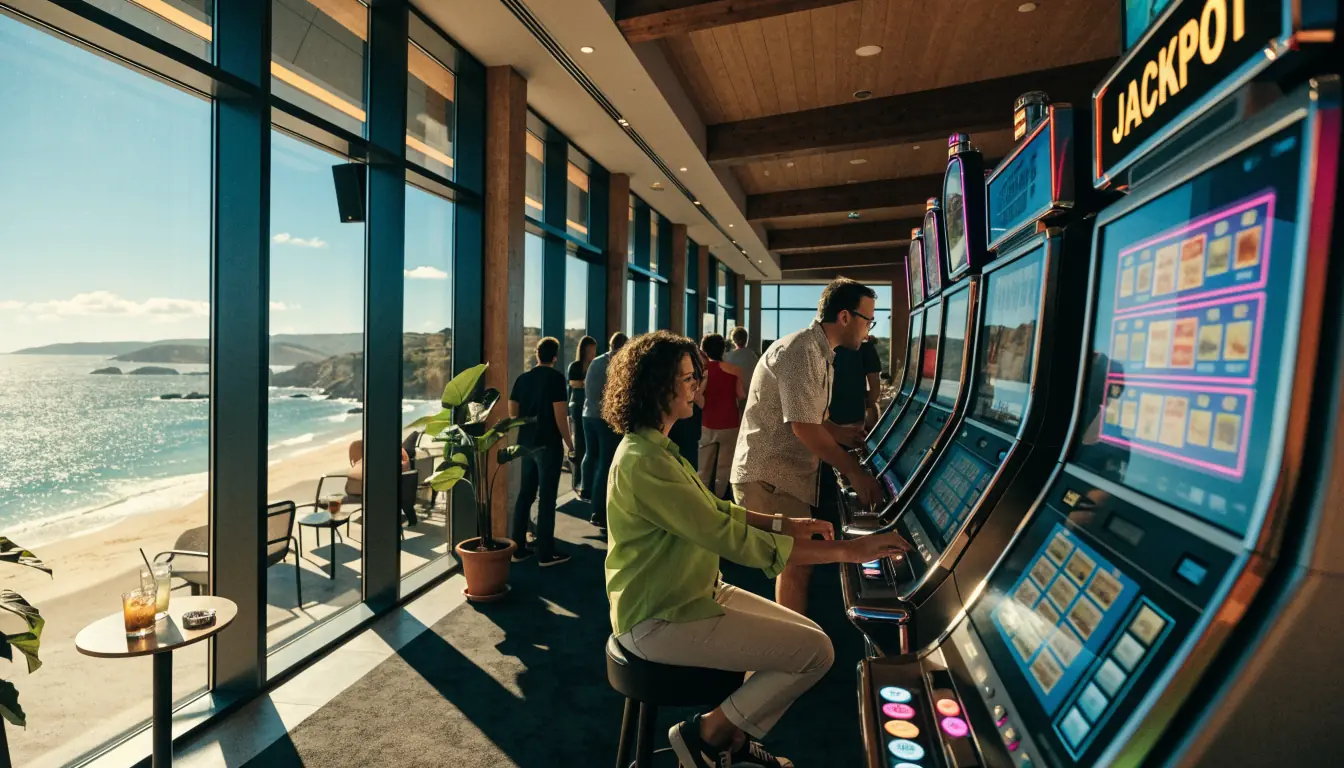
Why does the machine count matter beyond a statistic? Because prevalence shapes exposure. A state with tens of thousands of machines spread across everyday venues — the corner pub, the local club, the RSL — puts a pokie within easy reach of anyone who walks in for a meal or a drink. That accessibility is structurally different from an online slot, which requires deliberate access to a website. Physical machines are ambient; you encounter them as part of ordinary social spaces rather than by seeking out an internet address.
This also explains why regional concentration draws regulatory attention. A jurisdiction with a disproportionate share of national machine numbers carries a disproportionate share of the policy questions that follow — venue oversight, cash-handling controls, and compliance obligations for larger operators. Later sections cover the harm and financial-crime dimensions of that scale in more detail; the figures here are about where the machines physically sit and how many of them there are, which sets the baseline for everything built on top of it.
No comparable breakdown exists for how these totals split between casino-based machines and those in pubs and clubs specifically, or how the 18% global share has moved over recent years — the sources available report point figures rather than a time series, so trend claims beyond what’s stated here would go past what the data supports.
Casino Game Types Beyond Slots
Pokies dominate the gambling floor by sheer number, but they are not the whole picture. A physical casino venue in Australia typically runs table games alongside its gaming machines, and the mechanics of these games work on entirely different principles than a reel-based machine.
Table games and how they differ mechanically
A slot outcome comes from a random number generator running independently of anything happening around it. Table games work differently: the odds are fixed by the rules of the game itself, and the house edge comes from the payout structure rather than from a hidden probability engine. Blackjack, roulette, baccarat and poker variants all fall into this category. In a live venue, a dealer manages the game and the outcome is visible and physical — cards on a table, a ball in a wheel — rather than generated and displayed by software.
This distinction matters for understanding risk. A slot session is a series of independent events; the machine has no memory of your last spin. A table game session can involve strategy, decisions that shift the odds slightly, and interaction with other players or a dealer. Neither format is safer than the other, but they fail — and pay — in different ways, and conflating the two obscures what you’re actually playing.
Live dealer formats
Where a table game is offered through a screen rather than in person, a live dealer format streams a real dealer running the game in real time, with players placing bets remotely. This is a hybrid: the randomness comes from a physical shuffle or spin rather than software, but the interface and account structure resemble any other online gambling product. Evolution Gaming is one of the providers associated with this style of game, distinct from slot developers such as Pragmatic Play, Microgaming or NetEnt, whose output is exclusively reel-based.
Where this fits under Australian law
None of this changes the legal position that governs online casino games generally, slots included. Regardless of whether a game involves a reel, a wheel, or a dealt hand, offering it online to an Australian resident falls under the same prohibition — the format doesn’t create an exception. What differs between formats is only the mechanic, not the legal treatment.
Tax treatment is uniform across game types
One thing that does not vary by game type is taxation of winnings. Gambling winnings are not taxed in Australia, whether the win comes from a slot spin, a hand of blackjack, or a table bet placed through a live dealer stream. The tax burden in this sector sits with operators and the states, not with players: in 2015–16, gambling revenue accounted for 7.7% of state and territory taxation revenue, collected through licensing and taxation arrangements on the supply side rather than through any tax on individual winnings.

Why the distinction matters to a player
Understanding that "casino games" is a category, not a synonym for slots, changes how you read claims about odds, strategy, or fairness. A statement about random number generation applies to slots and to electronic versions of table games driven by software, but says nothing about a live dealer game or a physical table, where the randomness source is entirely different. Treating every casino product as interchangeable is where confusion about odds and outcomes usually starts.
Pokies – Scale, Impact and Risks
Pokies are electronic gaming machines, and the money moving through them in Australia is large enough to change how you should think about the format before you think about any specific game or venue. In the 2020–2021 financial year, Australians bet almost AUD$150 billion on these machines. Of that turnover, players lost AUD$12 billion — the difference between what goes in and what the machine returns over time, spread across every pub, club, and casino floor running the format.
Divide that loss across the population and the per-capita figure for that year comes to AUD$608. That number isn’t an average bet or a session cost — it’s what the machines took, per person, across the whole country, including people who never touched a pokie. It tells you the scale of the format relative to the size of the market, not what any individual player experienced.
Where the money lands
Venues profit from this turnover directly. NSW clubs alone earned $1.945 billion in net profit from pokies between December 2017 and May 2018 — a five-month window, not a full year. That figure comes from clubs specifically, a category distinct from pubs and casinos, and it shows how concentrated the revenue is in venues that rely on pokies as a core part of their business model rather than a side offering.
Why NSW is the reference point
NSW comes up repeatedly in any discussion of pokies harm for a reason: poker machines are recognised as the most harmful form of gambling in the state. That’s a specific finding about the format itself, not about problem gambling in general or about other casino games. It reflects how pokies are built — continuous play, rapid rounds, and a structure that keeps a player engaged for longer stretches than most other gambling formats found in the same venues.
That combination — high aggregate turnover, a measurable per-person loss, and a harm ranking that singles out this specific machine format — is what separates pokies from a generic casino game. The numbers aren’t spread evenly. A small number of high-frequency players and a concentration of machines in certain venues and regions account for a disproportionate share of both the turnover and the losses described above. If you’re trying to understand why pokies attract more regulatory and public health attention than other gambling formats in Australia, this is the underlying reason: the scale of money moving through them, and the harm profile attached to that specific machine type in the state where it has been studied most closely.
None of this changes what a pokie is mechanically — a machine, whether coin-operated or account-based, running a fixed set of paylines and a return structure set by the manufacturer. What it changes is the weight you should give to caution around session length and spend, given that the format itself, independent of any single venue or operator, carries a demonstrated harm profile at this scale.
Real‑Money Slot Play: Taxation and Financial Rules
Playing pokies for real money in Australia sits inside a legal framework that treats the player differently from the operator. No domestically licensed real-money online casino exists, and it is illegal to offer online casino gambling to Australian residents. But the law targets operators, not individuals — an Australian who plays at an offshore-licensed site is not breaking the law by doing so. That distinction matters for anyone trying to understand where the real financial rules apply.
One area where the rules are simple: winnings are not taxed. Whether the money comes from a pub pokie or an offshore slot session, the tax office does not treat gambling proceeds as assessable income for recreational players. That said, gambling revenue itself is not a footnote for state and territory budgets — it made up 7.7% of state and territory taxation revenue in 2015‑16, collected mostly through duties on operators and venues rather than through anything charged to individual players.
The financial rules that carry real weight involve cash movement, not tax returns. Because pokies and slot venues handle high volumes of cash, financial intelligence bodies watch for specific patterns rather than specific amounts won or lost. Two indicators repeat across guidance on this: a customer having access to more cash than would be expected for their profile, and a customer depositing higher values or larger sums of cash than their typical pattern shows. Neither indicator depends on whether the money was won or lost — it depends on whether the cash flow matches the person moving it. That framing separates real-money slot play from a compliance question, and turns it into a question of who is watching the money, not the game.
Cryptocurrency Slots: Bitcoin and Beyond
Search results promising Bitcoin casino gambling or a Litecoin gambling casino site are aimed at Australians because interest in crypto-funded slots is real, not because a legal path exists for it. The Interactive Gambling Act 2001 prohibits offering online casino games — slots included — to Australian residents regardless of what currency backs the transaction. Bitcoin does not sit outside that law. It sits inside a payment layer that operators are separately barred from using: accepting digital currencies for deposits or bets is one of the restrictions this market enforces on any gambling site targeting Australians.
That leaves two separate questions that are easy to blur together. One is whether an Australian can technically send Bitcoin to an offshore platform advertising itself as a bitcoin casino gambling site. The other is whether doing so is authorised under Australian law. It is not the player who is targeted by the Interactive Gambling Act — the law is written to catch operators, not individuals placing bets — but that distinction does not create a licensed, regulated bitcoin gambling casino option inside Australia. No such licence exists here, for cryptocurrency-funded slots or for any other online casino format.
Why there’s no dedicated data
Every figure earlier in this article — the AUD$150 billion wagered on electronic gaming machines, the AUD$608 per-capita loss, the 3% share of the world’s pub and club poker machines sitting in Australia — comes from tracking systems built around cash and card transactions at physical pokies and regulated wagering products. None of that measurement infrastructure extends to Bitcoin, Ethereum, or any other cryptocurrency used on offshore slot sites. There is no official register of how much Australian money moves through a bitcoin casino online gambling platform, because those platforms operate outside the licensing perimeter that would normally generate that data. Regulators publish figures for what they oversee; cryptocurrency slot activity falls outside that scope by definition, so no dedicated data exists for it.
This absence matters more with crypto than with card payments, because the traceability problem compounds. AUSTRAC’s concerns about pokies as a money-laundering risk area centre on cash placed into a machine with minimal play and withdrawn shortly after. Cryptocurrency transactions carry a different but related weakness: value can move across wallets and platforms with limited identity verification unless the receiving service enforces its own checks. An offshore site advertising an online casino gambling bonus paid out in Bitcoin is not required to meet Australian customer due diligence standards, because it is not licensed in Australia to begin with.
Litecoin, Ethereum, and other currencies marketed alongside Bitcoin on these sites face the same regulatory gap — not a lighter version of it, and not a different one. The absence of licensing is not a technicality tied to which coin is used; it applies to the underlying product, which is an online casino, and the Interactive Gambling Act’s prohibition does not change based on the payment rail chosen.
Ethereum and Internet‑Based Slot Platforms
Ethereum works as a settlement layer the same way Bitcoin does: transactions post to a public ledger, and a site accepting Ether can, in principle, trace the path of every deposit and withdrawal back to a wallet address. That traceability is the technical property worth understanding, separate from whether a platform offering Ethereum wagering can legally serve an Australian resident under the Interactive Gambling Act 2001 — it cannot, regardless of which cryptocurrency it accepts.
The more useful comparison sits closer to home, inside licensed venues. Traditional coin‑and‑note pokies leave a thin trail: cash goes in, cash or a ticket comes out, and little else is recorded about who did the transaction. Cashless, account‑based pokies change that. A patron logs into an account before playing, and every deposit, spin outcome, and cash‑out ties back to a verified identity rather than to an anonymous machine interaction. This is why the term "transparent pokies" is used for account‑based systems specifically — the transparency refers to the record, not to the odds or the mechanics of the reels.
For venues, this account structure supports the same controls that anti‑money-laundering programs rely on elsewhere: customer verification at sign‑up and ongoing patron profiling to flag behaviour that doesn’t match a person’s usual pattern. A ledger that links a name to every transaction gives compliance staff something to check. A machine that only counts coins does not.
Online Casino Slot Offerings in Australia
Searching for online casino gambling in Australia turns up plenty of offshore sites advertising slots, but no domestically licensed operator can legally offer them. The Interactive Gambling Act 2001 prohibits providing online casino games — slots included — to Australian residents. That prohibition falls on the operator, not the player: there’s no penalty for an individual who signs up with an offshore site, but that also means no local licence, no local dispute process, and no regulator standing behind the games.
This is why a landscape of "online casino gambling Australia" listings exists at all despite the ban — the sites are licensed elsewhere, outside Australian jurisdiction, and marketed to Australian players regardless.
Player protection infrastructure has grown around this gap rather than through it. BetStop, the national self-exclusion register, launched in August 2023 and had 18,000 people registered within its first six months — a sign of how many Australians were actively trying to limit or stop their own gambling activity, slots included. Self-exclusion through BetStop covers licensed wagering services; it doesn’t reach into offshore casino platforms, which sit outside the scheme entirely.
The state revenue side gives some sense of scale: gambling revenue made up 7.7% of state and territory taxation revenue in 2015-16, a figure that reflects licensed wagering and lotteries rather than the offshore slot sites this section is describing.
Top Australian Casinos and Their Slot Play Options
Before you pick a slots site to play on in 2026, it helps to see how each casino stacks up on licensing, bonus structure, and payout speed so you can match a site to what actually matters to you.
License: Curacao · Bonus: 100% up to A$500 + 200 free spins, 10x wagering · Payout speed: crypto 30-60 minutes, fiat 1-5 days · Min. deposit: A$10 Curacao-licensed site offering a solid deposit match plus free spins with 10x wagering, and it stands out for fast crypto payouts alongside more conventional fiat processing times.
Bonus: up to A$7,500 + 550 free spins across 10 deposits, 50x wagering · Payout speed: crypto under 1 hour, PayID 1-3 business days · Min. deposit: A$20 (A$30 to qualify for the bonus) Built around a large multi-deposit welcome package with free spins spread across ten deposits, backed by quick crypto cashouts and PayID as a fiat option.
License: Curacao eGaming OGL/2024/923/0383 (Antillephone N.V.) · Bonus: up to A$2,000 + 100 free spins across 2 deposits · Min. deposit: A$30 Licensed under Curacao eGaming via Antillephone N.V., with a two-deposit welcome bonus including free spins and an accessible minimum deposit.
License: Tobique Gaming Commission · Bonus: up to A$8,000 + 400 free spins across 4 deposits · Payout speed: crypto ~10-15 minutes, fiat 1-5 days · Min. deposit: A$30 Holds a Tobique Gaming Commission license and pairs a sizeable four-deposit bonus with notably fast crypto withdrawal times.
License: Curacao · Bonus: up to A$10,000 multi-stage + 500 free spins · Min. deposit: A$20 (POLi) Curacao-licensed casino with a large multi-stage bonus and free spins, and it supports POLi for deposits starting at a low minimum.
License: Curacao eGaming (Hollycorn N.V., since 2017) · Bonus: 225% up to A$1,540 + 600 free spins across 4 deposits, 20x wagering · Min. deposit: A$20-30 (depends on the offer) Long-standing Curacao eGaming operator run by Hollycorn N.V., offering a four-deposit bonus with free spins and comparatively light 20x wagering requirements.
License: Curacao Gaming Control Board OGL/2023/176/0095 (Hollycorn N.V.) · Bonus: up to A$5,000 + 300 free spins across 4 deposits Licensed by the Curacao Gaming Control Board under Hollycorn N.V., with a four-deposit welcome bonus that includes a generous free spins allocation.
License: Curacao eGaming (Roby Games Ltd) · Bonus: 100% up to A$750 + 200 free spins Operated under a Curacao eGaming license by Roby Games Ltd, offering a straightforward deposit match bonus with free spins included.
Bonus: 100% up to A$750 + 200 free spins, 35x wagering · Payout speed: crypto 30-120 minutes, fiat 24-72 hours · Min. deposit: A$30 Offers a deposit bonus with free spins under 35x wagering, and it processes crypto withdrawals quickly while fiat payouts follow a short standard turnaround.
License: Curacao eGaming OGL/2023/174/0082 (Dama N.V.) · Bonus: up to A$10,000 + 500 free spins across 4 deposits · Min. deposit: A$15 Licensed under Curacao eGaming via Dama N.V., featuring one of the larger four-deposit bonus packages along with a low minimum deposit requirement.
There is no domestically licensed online casino to rank. The Interactive Gambling Act 2001 prohibits operators from offering online casino games, including slots, to Australian residents, so no "top Australian casino" exists as a legal, locally licensed real-money slot site. Any list claiming otherwise is describing an offshore operator, not an Australian one — and playing there is not illegal for the individual, but the operator is not accountable to any Australian regulator.
What exists instead, and what actually carries scale, is the land-based pokies network in pubs, clubs, and licensed venues. That network is where the turnover and the risk concentrate. High volumes of cash moving through machines, combined with limited traceability at the point of play, are exactly why public inquiries and sector guidance repeatedly flag pokies venues as a major area for money-laundering risk — not because slot mechanics themselves are suspicious, but because cash-in, cash-out patterns are hard to distinguish from ordinary play without proper controls.
So framing "top casinos" around slot variety or bonus terms misses the actual comparison worth making on this market: which venues operate under scrutiny, report large cash transactions, and apply customer due diligence — versus which merely process volume. That distinction matters more here than any list of names ever could.
What are the top welcome bonuses for Australian players in 2026?
Gambling winnings are not taxed in Australia, so you keep 100% of your bonus-derived payouts.
How can I manage deposits and withdrawals responsibly?
You can register with the BetStop self-exclusion registry, which launched in August 2023, to voluntarily block yourself from depositing or withdrawing funds across licensed gambling platforms.
What payment methods are available for Australian players at online casinos?
While physical pokies historically rely on cash and note acceptors, moving towards cashless and account-based systems improves traceability, and similar account-based deposit methods are standard for online platforms to monitor transactions.
How did Covid-19 lockdowns affect land-based casinos and boost online gambling?
During the FY 2020-2021 lockdowns, Australians bet almost AUD$150 billion on electronic gaming machines, losing AUD$12 billion, illustrating a massive sustained demand for reel-based gambling that online sites heavily capitalized on.
Created by the ”Pokies Live Guide” editorial team.