
Live Baccarat Online Casino Australia: Legal Guide

- Australian Online Baccarat Casinos: Legal Framework and Availability
- Understanding the Baccarat Game: Core Mechanics and Betting Options
- Live Baccarat Streams: How Real‑Time Tables Operate Online
- Real‑Money Live Dealer Baccarat: Payment, Identity Verification and AML Requirements
- Assessing the Quality of Baccarat Casinos for Australian Players
- Step‑by‑Step Guide: How to Play Baccarat at an Online Casino
- Bonuses, Cryptocurrency and Odds in Australian Baccarat Casinos
- What Makes a Baccarat Casino ‘Top‑Rated’ for Australian Users?
- Choosing a Baccarat‑Friendly Online Casino Site
- Baccarat Rules: Detailed Breakdown of Gameplay
Australian Online Baccarat Casinos: Legal Framework and Availability
Before looking at how a live baccarat table works or what a betting round involves, it’s worth settling a more basic question: is any of this legal to access from Australia in the first place? The honest answer has two layers, and both matter.
At the federal level, the Interactive Gambling Act 2001 prohibits online casino-style games — slots, poker, blackjack, roulette, and baccarat among them — from being offered to people in Australia. This is not a licensing gap that a workaround might close later; it’s a direct prohibition on the provision of these services domestically. As a result, there are no domestically licensed real-money online casino operators available to Australian players. No state or territory issues a licence for an online baccarat casino, because the activity the licence would cover is barred under federal law. If a site claims an Australian online casino licence for baccarat, that claim doesn’t correspond to anything that actually exists.
This is where the offshore distinction becomes important. Australians who play baccarat online are, in practice, playing on platforms licensed elsewhere — typically by authorities such as Malta Gaming Authority or the UK Gambling Commission. The law’s target is the operator, not the individual player: offering the service into Australia is what’s prohibited, not the act of an Australian sitting down at a table hosted from overseas. That’s a meaningful legal nuance, but it also means there is no Australian regulator standing behind these games, no local licence to check, and no domestic consumer protection framework covering the transaction.
Before you sit down at a live baccarat table, it’s worth knowing how each casino handles licensing, deposits and payouts, since these details shape how smooth your real-money experience will be.
License: Curacao · Bonus: 100% up to A$500 + 200 free spins, 10x wagering · Payout speed: crypto 30-60 minutes, fiat 1-5 days · Min. deposit: A$10 Curacao-licensed and accessible with a low minimum deposit, this casino backs its offer with a sizeable welcome package including free spins, plus fast crypto withdrawals for players who prefer digital currency.
Bonus: up to A$7,500 + 550 free spins across 10 deposits, 50x wagering · Payout speed: crypto under 1 hour, PayID 1-3 business days · Min. deposit: A$20 (A$30 to qualify for the bonus) This operator stands out for its extended welcome package spread across multiple deposits, with free spins included, and it caters to both crypto users and PayID bank transfers for withdrawals.
License: Curacao eGaming OGL/2024/923/0383 (Antillephone N.V.) · Bonus: up to A$2,000 + 100 free spins across 2 deposits · Min. deposit: A$30 Holding a Curacao eGaming license under Antillephone N.V., this casino offers a two-deposit welcome bonus with free spins and a modest entry point for new players.
License: Tobique Gaming Commission · Bonus: up to A$8,000 + 400 free spins across 4 deposits · Payout speed: crypto ~10-15 minutes, fiat 1-5 days · Min. deposit: A$30 Licensed by the Tobique Gaming Commission, this casino offers a generous multi-deposit welcome bonus with free spins, plus quick crypto payouts for players wanting fast access to winnings.
License: Curacao · Bonus: up to A$10,000 multi-stage + 500 free spins · Min. deposit: A$20 (POLi) This casino offers a substantial multi-stage bonus with free spins and keeps the entry deposit accessible, including support for POLi as a payment method.
License: Curacao eGaming (Hollycorn N.V., since 2017) · Bonus: 225% up to A$1,540 + 600 free spins across 4 deposits, 20x wagering · Min. deposit: A$20-30 (depends on the offer) Licensed under Curacao eGaming since 2017 via Hollycorn N.V., this casino provides a multi-deposit welcome bonus with a large free spins allocation and a manageable wagering requirement.
License: Curacao Gaming Control Board OGL/2023/176/0095 (Hollycorn N.V.) · Bonus: up to A$5,000 + 300 free spins across 4 deposits Operating under a Curacao Gaming Control Board license through Hollycorn N.V., this casino offers a solid welcome bonus with free spins spread over several deposits.
License: Curacao eGaming (Roby Games Ltd) · Bonus: 100% up to A$750 + 200 free spins Licensed via Curacao eGaming under Roby Games Ltd, this casino keeps things straightforward with a welcome bonus that includes a matched deposit and free spins.
Bonus: 100% up to A$750 + 200 free spins, 35x wagering · Payout speed: crypto 30-120 minutes, fiat 24-72 hours · Min. deposit: A$30 This casino combines a welcome bonus with free spins and a clear wagering requirement, alongside reasonably fast payout options for both crypto and fiat users.
License: Curacao eGaming OGL/2023/174/0082 (Dama N.V.) · Bonus: up to A$10,000 + 500 free spins across 4 deposits · Min. deposit: A$15 Backed by a Curacao eGaming license through Dama N.V., this casino offers one of the more generous multi-deposit welcome packages with free spins and a low minimum deposit requirement.
Why there’s no single regulator to point to
Australia doesn’t have one gambling authority the way some markets do. Regulation is split between the Commonwealth and the states/territories, and each layer covers a different slice of the picture:
- ACMA (Australian Communications and Media Authority) enforces the Interactive Gambling Act 2001 at the federal level — this is the body responsible for identifying and acting against illegal offshore casino services reaching Australian users.
- State and territory regulators each govern gambling within their own jurisdiction, and none of them issues online casino licences either, since the federal prohibition applies nationwide.
- The Northern Territory Racing Commission (NTRC) has become the de-facto licensing body for most national online bookmakers, largely because of the lower tax rate it offers — but its remit is sports and race wagering, not casino games like baccarat.
- The Victorian Gambling and Casino Control Commission (VGCCC) monitors wagering service providers for compliance with the National Consumer Protection Framework, including operators based in other states — again, a wagering-focused function rather than an online casino one.
Land-based casinos sit in a separate box entirely. Physical casino venues are licensed and supervised by state government regulators and law enforcement agencies, and that oversight has no bearing on what happens online. A brick-and-mortar casino licence in one state says nothing about the legality or safety of an internet baccarat table — the two are regulated through completely different mechanisms, by different bodies, under different laws.
What this patchwork means for reach and enforcement
Because state and territory regulators like the VGCCC or Liquor & Gaming NSW have jurisdiction that stops at the border of their own state’s licensed operators, they have limited practical power over offshore online casinos. A Malta- or UK-licensed baccarat site operating from outside Australia isn’t something a Victorian or New South Wales regulator can directly discipline, fine, or shut down — their authority simply doesn’t extend that far. ACMA is the body with a federal mandate to act against offshore services reaching Australian residents, but even that enforcement operates at the level of the service, not the individual game table.

The practical result is that no Australian authority — state, territory, or federal — grants a licence that says "this baccarat casino is approved to operate in Australia." That licence doesn’t exist because the law doesn’t permit it to exist. Any operator serving Australian players is doing so under a licence from another jurisdiction, and Australian regulators’ role is limited to policing access from the outside rather than supervising the operator from within.
What is actually licensed onshore
To avoid confusion later in this guide, it helps to be precise about what Australian gambling law does permit. Online sports and race betting is legal under state and territory licences — this is the part of the online gambling market with a genuine domestic licensing regime, regulators like the NTRC, and consumer protections that apply directly. Lotteries follow a similar pattern. Online casino games, including baccarat, fall outside that regime entirely. This split explains why you’ll see Australian-licensed bookmakers advertise openly, while no equivalent exists for online baccarat.
Playing live baccarat online from Australia carries legal risk because operators are offshore; ACMA can block access and you may lose the ability to reach the site.
Reading this section practically
None of this makes playing baccarat online a criminal act for an individual in Australia — the law is written to target operators, not players. But it does mean a few things worth carrying into the rest of this guide: there’s no domestic licence to look for, no Australian regulator to check a site against, and no public register of approved online casinos because none has been approved to exist. Any assessment of a baccarat platform’s standing has to rest on its offshore licence and the oversight that licence actually provides, since Australian regulatory bodies simply don’t issue or police one for this category of game.
The sections that follow build on this footing — starting with how baccarat itself is played, and later moving into what a live-dealer stream involves, how identity and payment checks work in practice, and what separates a well-run offshore platform from a poorly run one. All of that sits on top of the same underlying fact: the legal foundation for online baccarat in Australia is offshore by necessity, not by operator choice.
Understanding the Baccarat Game: Core Mechanics and Betting Options
Baccarat runs on arithmetic, not strategy. Once you understand how the cards are counted and what the three bets actually pay for, the rest of the game is mechanical repetition — which is exactly why it has stayed popular across so many casino formats, live or otherwise.
Card values and hand totals
Every card in baccarat carries a fixed point value, and the only number that matters is the final digit of the total:
- Aces count as 1.
- Cards 2 through 9 count as their face value.
- 10s, Jacks, Queens and Kings all count as 0.
Two cards are dealt to the "Player" hand and two to the "Banker" hand. Add the values together and drop the tens digit — a hand of 7 and 8 totals 15, which counts as 5. The highest possible hand value is 9; there’s no bust, because any total above 9 simply loses the leading digit.
A third card is drawn to either hand under a fixed set of rules tied to the first two cards’ total — the player and the banker don’t choose whether to draw. If either hand shows 8 or 9 from the first two cards, that’s a "natural," and no further cards are drawn at all. Everything else follows a table of forced draws built into the game itself, whether you’re playing it on a screen or watching a croupier deal it live.
The three main bets
Before any cards are dealt, you choose which side you’re backing:
| Bet | What it’s predicting |
|---|---|
| Player | The Player hand will have a higher total after the draw |
| Banker | The Banker hand will have a higher total after the draw |
| Tie | Both hands will finish with the same total |
The Banker bet wins slightly more often than the Player bet across the long run of hands, which is why casinos typically apply a commission to Banker wins rather than paying it out at even money outright. The Tie bet pays out at long odds because it happens far less frequently than either of the other two outcomes — it’s a high-variance side bet, not a core strategy.
None of the three bets require you to make further decisions once placed. There’s no drawing a card "on request," no doubling down, no splitting. The dealing rules govern the third card automatically, which is part of why baccarat is often described as having a lower house edge than many other table games — the outcome is determined by fixed procedure rather than player skill or judgment calls.
Side bets and variants
Beyond the three primary outcomes, many baccarat tables — physical and online — offer side bets tied to specific card combinations, such as pairs appearing in the first two cards dealt to either hand. These side bets sit outside the core Player/Banker/Tie structure and carry their own separate payout odds. They don’t change how the main hand resolves; they’re an additional wager placed alongside your primary bet.
Variants of the game exist too. Some tables let players handle the cards themselves under supervision; others run entirely through a dealer or an automated shoe. The scoring, the draw rules and the three main bets stay the same across variants — what differs is presentation and pace, not the underlying mechanics.
What the player actually decides
Because the drawing rules are fixed, the only real decisions in a hand of baccarat are:
- Which of the three main bets to place — Player, Banker or Tie.
- Whether to add any side bet on top of that.
- How much to stake.
That’s the entire decision tree for a single hand. There’s no mid-hand choice that changes the cards you’re dealt, which is different from games like blackjack where a player’s call on hitting or standing directly shapes the outcome. Baccarat’s appeal for many players comes precisely from this: once the bet is down, the hand plays itself according to rules that don’t vary by table or operator.
Random number generation versus dealt cards
In non-live baccarat formats, the deal is produced by random number games running the same underlying probabilities as a physical deck, verified to match the standard card distribution. In live formats, an actual shoe of cards is dealt by a croupier and the same draw rules apply to whether a third card is shown. The mathematics behind both formats is identical — the difference is in how the cards are generated and shown to you, not in what beats what or how the payouts are structured. That distinction becomes relevant when comparing live-dealer streams to standard video-based baccarat, which is a separate question from the rules themselves.
Bet on the Player hand to have a higher total after the draw.
Bet on the Banker hand to have a higher total; this bet wins slightly more often but usually carries a commission.
Bet that both hands will finish with the same total; pays long odds.
It’s worth being clear about where this knowledge is legally relevant in Australia: the mechanics described above apply to baccarat as a game, wherever it’s offered. Whether an Australian resident can access a given version of it online is governed separately by the Interactive Gambling Act — dated 1997 in some references and 2001 in others, depending on the source — which restricts the offering of online casino games to Australian residents. Understanding how baccarat works and understanding where you’re legally permitted to play it are two different questions, and the game’s mechanics don’t change based on jurisdiction.
Live Baccarat Streams: How Real‑Time Tables Operate Online
A live baccarat table replaces the random number generator with a physical shoe of cards, a croupier, and a camera feed. The core difference from a standard video game is where the outcome is decided. In a random number game, a server generates the result and animates it on screen. In a live-dealer stream, a person in a studio shuffles, deals, and reveals cards in real time, and the video feed is what the platform sells you as proof that nothing was pre-generated.
A short buffer is built into most live‑dealer platforms to compensate for minor connection lags, ensuring your bet is still accepted even if your internet slows briefly.
What the stream actually shows you
The setup is a studio built to look like a casino pit: a table, a shoe, a croupier, and several cameras pointed at the same spot from different angles. One camera usually gives a wide view of the table, another sits close on the card reveal, and a third may cover the shoe itself. The video is encoded and pushed to your browser or app as a continuous feed, with a betting interface overlaid on top so you can place chips without touching the table itself.
Card recognition software reads the values as they’re dealt and feeds that data into the betting system almost instantly, which is how the site can settle your bet and update the display within moments of the reveal, rather than waiting for a person to type in the result. This is also why live tables can run through hands quickly compared with what you might expect from a physical casino floor — there’s no need to manually reconcile chips or wait for a pit boss.
Why this differs from a video baccarat game
A video or "RNG" baccarat table draws each card from a certified random number generator and displays the outcome through pre-rendered or computer-generated graphics. There’s no camera, no croupier, and no shoe — the entire game exists as code running on a server. Live baccarat exists specifically to remove that abstraction: the shoe you watch being shuffled is the actual mechanism producing your result, and the croupier’s actions are the audit trail, visible to you as it happens rather than something you have to trust after the fact.
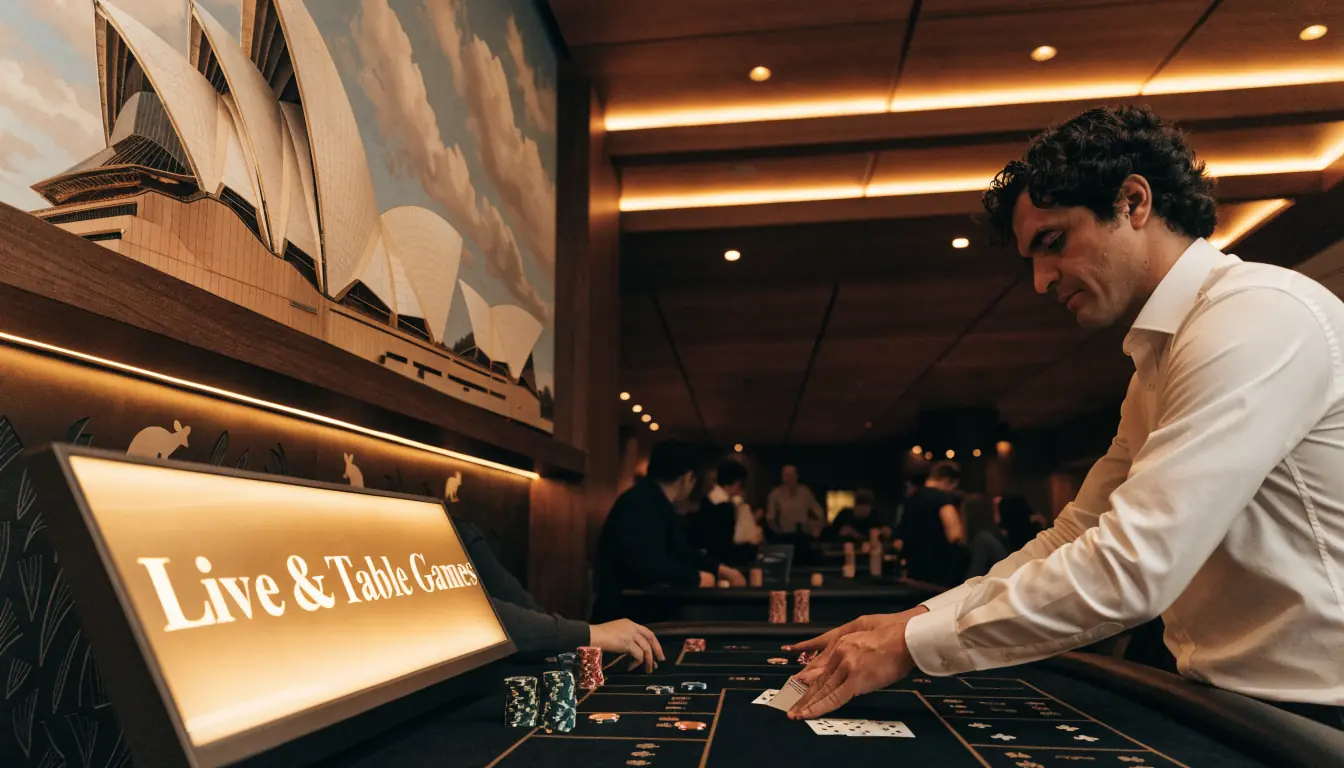

That distinction matters for how you read the game. With a video table, questions about fairness are questions about the random number generator and its certification. With a live table, the same questions are about the studio’s card-handling procedures, camera coverage, and whether the feed you’re watching is genuinely continuous rather than edited or delayed. Both formats are being played for real money and both display a house edge baked into the payout structure, but the mechanism generating each hand is fundamentally different.
Real time means real time — with one legal exception
"Live" in the name refers to the dealing, not to how you’re allowed to place your bet. Live baccarat streams run continuously and let you bet on each hand as it’s dealt, hand after hand, without pause. This is the same real-time structure that in-play sports betting relies on, and it’s worth being precise about the law here: live, in‑play online betting is illegal in Australia. The one carve-out in the legislation is that placing a live bet by phone remains legal, which is a distinction that matters for wagering but has no direct bearing on how a baccarat stream itself operates as a game.

Connection and access
Streaming a live table requires a stable connection, since the feed has to hold sync with the betting window closing at the right moment — if your connection lags behind the dealer’s actions, you risk trying to place a bet after the window has shut. Most platforms build in a short buffer for this reason, but the practical effect is that live baccarat is less forgiving of a poor connection than a video table, where the outcome only appears once you’ve already committed your bet.
Access to any of these streams from Australia depends on the platform being reachable at all. Since November 2019, the Australian Communications and Media Authority has issued blocking orders to internet service providers targeting offshore gambling sites operating outside Australian law, which means a live baccarat stream that was reachable at one point can later be blocked at the ISP level without the platform itself changing anything about how its tables run. The technology behind the stream — cameras, card recognition, real-time betting — stays the same regardless; what changes is whether your connection to it is allowed to reach the server in the first place.


Real‑Money Live Dealer Baccarat: Payment, Identity Verification and AML Requirements
Playing baccarat with a live croupier for real money moves the transaction outside Australia’s regulated financial system the moment you fund an account with an offshore operator. That has practical consequences for how money moves, what identity checks apply, and what happens if something goes wrong — separate from the question of whether the site is reachable at all, which is a matter of legality rather than payment mechanics.
How funds move
No domestically licensed real-money online casino operator exists for Australian players, so any live dealer baccarat table processing real bets sits on infrastructure run from outside the country. That means deposits and withdrawals pass through payment processors, e-wallets or banking rails that are not subject to the same domestic consumer-protection rules that apply to, say, a state-licensed wagering account. Credit cards and digital currencies are not accepted for deposits or betting on platforms that follow Australian restrictions, which narrows the practical payment options to bank transfers and e-wallet services.
Identity verification before withdrawal
Anti-money-laundering obligations require identity verification for all withdrawals. In practice, this means submitting government-issued identification before a payout is released — not before you start playing, but before the operator lets money leave the account. This check exists to confirm you are the account holder and that funds are not being moved through the platform to obscure their origin. Expect the request at the point of cashing out rather than at registration; a platform that skips this step entirely is not doing you a favour, it is skipping a control that exists for your protection as much as the operator’s.
Withdrawal risk
If an offshore operator delays or refuses to pay out, Australian regulators have no power to recover your money.
The limits of enforcement
The Australian Communications and Media Authority can investigate and block prohibited interactive gambling services, and it can order internet service providers to cut off access to sites operating illegally. What it cannot do is recover funds or settle a dispute between a player and an offshore operator. If a withdrawal is delayed, disputed, or simply not paid, ACMA’s enforcement powers stop at blocking the site — they do not extend to acting as an arbitrator over your money. According to a report by iclg.com, as of August 2025 ACMA had blocked 1,296 illegal gambling sites and affiliates since 2019, and 220 illegal services had voluntarily exited the Australian market; that figure describes enforcement activity against unlicensed operators, not a guarantee of financial recovery for individual players who have already deposited funds with one.
This is the practical gap between legality and safety. An operator can be within reach of Australian players — because the law targets operators, not the individuals who play — while still sitting entirely outside any complaint mechanism that could compel it to pay out a disputed withdrawal.
What identity checks mean for you
| Stage | What is checked | Why it matters |
|---|---|---|
| Withdrawal request | Government-issued ID matching account details | Confirms you control the account being paid |
| Repeated large transfers | Source and pattern of funds | Anti-money-laundering monitoring, not a penalty on the player |
| Dispute over a payout | No independent Australian authority to intervene | ACMA can block the site, not resolve the claim |
None of this replaces reading the operator’s own terms on processing times or verification documents required — those specifics are not published by any Australian regulator, because none licenses these operators domestically. What is established is the mechanism: identification is tied to withdrawal, not deposit, and the enforcement bodies that can act against an illegal service have no mandate to act on your behalf once money has already changed hands.
Assessing the Quality of Baccarat Casinos for Australian Players
There is no domestic licence for real-money online baccarat, and no register where you could look one up. That single fact changes what "quality" even means here. You are not choosing between a licensed local operator and an unlicensed one — every real-money baccarat site reachable from Australia operates under a foreign licence, typically issued by a regulator such as Malta Gaming Authority or the UK Gambling Commission. Assessing quality, then, is less about "is this legal" and more about "what does this operator actually do to protect me, and can I verify any of it."
Where the offshore licence actually comes from, and why it matters
A licence issued by Malta or the UK does not put the operator under Australian jurisdiction. ACMA cannot license, audit or discipline these companies the way a domestic regulator would. What ACMA can do is request that internet service providers block a site’s access from Australia, and it can write to software developers and other parties it considers ancillary to a breach of the Interactive Gambling Act. That gives ACMA a way to make a site harder to reach — it does not give Australian players a way to file a complaint with ACMA and get a dispute resolved. The practical consequence: the strength of a baccarat casino’s overseas licence tells you something about how the site is audited abroad, but it tells you nothing about recourse if something goes wrong for you specifically.
Quality assessment checklist
- Look for a clear licence number and issuing jurisdiction in the site footer.
- Verify responsible‑gambling tools such as deposit limits and self‑exclusion are easily accessible.
- Check that age‑gating is enforced before you can navigate the site.
- Ensure the identity‑verification process is explained and only triggered on withdrawal.
- Confirm the presence of a dedicated dispute or ADR contact, not just a generic support email.
What you can actually check yourself
Since there is no local register to consult, quality assessment shifts to what is visible on the site itself:
- Licence display — the footer should name the issuing regulator and a licence number, not just a badge image.
- Responsible-gambling tools — deposit limits, time limits and self-exclusion options should be reachable from the account settings, not buried in a help article.
- Age gating — the site should not be accessible or navigable without confirming you are 18 or older, given that close to a third of Australians aged 12–17 already report gambling activity and nearly half of 18-year-olds do.
- Identity verification process — a casino that asks for ID only at withdrawal, with no explanation of why, is doing the legal minimum rather than being transparent about it.
- Complaint and dispute pathway — a genuine alternative dispute resolution contact, separate from a generic support email, indicates the operator expects to be held accountable somewhere.
What quality is not
Quality is not a marketing badge, a "safe and secure" banner, or a high volume of bonus offers. None of those are audited by anyone with authority over the operator. It is also not the same as legality — an offshore casino can be technically reachable by an Australian player (the law targets operators, not individuals) while still being a poor operator on every measure above. Conversely, ACMA’s ability to pursue software providers and request ISP blocking means some offshore sites disappear from easy reach entirely, regardless of how they treated players while they were accessible.
The honest baseline is this: judging a baccarat casino from Australia means judging disclosure, not jurisdiction. A site that shows its licence number, explains its verification steps before you hit a withdrawal wall, and gives you working limit-setting tools has demonstrated more about its quality than any claim of being "top-rated" ever could.
Step‑by‑Step Guide: How to Play Baccarat at an Online Casino
Playing baccarat online follows the same basic sequence at almost every offshore site accessible to Australians: register, verify, fund, play, withdraw. What changes between operators is how strictly each step is enforced — and that strictness is usually a sign of how seriously the site takes its own compliance obligations.
1. Create an account
You’ll need an email address, a password, and basic personal details — name, date of birth, residential address. The date-of-birth field isn’t a formality: the site is required to confirm you’re 18 or older before letting you proceed. Some platforms ask for this information upfront; others defer it until withdrawal, which is worth noting because it affects when you actually find out whether your documents will be accepted.


2. Verify your identity
Even if a site lets you deposit and play before verifying, it cannot let you withdraw without government-issued ID. This isn’t optional or site-specific — it’s a baseline anti-money-laundering control. Expect to upload a passport or driver’s licence, and in some cases a proof-of-address document. Do this early rather than after you’ve won something; if the documents don’t clear, the delay happens at the worst possible moment.
3. Fund your account
Deposit methods vary by operator, but whatever method you use, the site should show the licence it operates under before you commit any funds. If you can’t find that information, that’s a signal about the operator, not a technicality to skip past.
4. Choose a baccarat table
Once funded, you’ll find baccarat listed either under table games or under a live dealer section, depending on whether you want a random-number-generated version or a streamed table with a croupier. The table listing typically shows the betting range for that particular table before you sit down — check it before committing funds, since ranges differ from table to table.
5. Place your bet
Baccarat gives you three basic bets: Player, Banker, or Tie. You select your chip value, click the betting area you want, and confirm before the round starts. Once the cards are dealt, you cannot change or cancel the bet — there’s no undo function once the round is locked in.
6. Watch the outcome and collect winnings
Winnings are credited to your account balance automatically once the hand resolves. There’s no separate claim step for a single-round win — the balance simply updates.
Step‑by‑step account setup
Enter your email, password, name, date of birth and residential address; the site will confirm you are over 18.
Upload a government‑issued ID (passport or driver’s licence) and, if required, a proof‑of‑address document.
Choose an accepted payment method, review the offshore licence displayed, and make a deposit.
7. Withdraw your funds
This is where identity verification matters again. If you haven’t completed it earlier, the withdrawal request will trigger it now, and the payout won’t process until the documents are reviewed and accepted. Set bankroll and time limits before you start playing, not after — most platforms offer these controls in account settings, and using them before your first session is the only point at which they’re genuinely preventive rather than reactive.
A note on where you’re playing
Because no operator holds a domestic licence to offer these games to Australians, every step above happens on an offshore platform. The Australian Communications and Media Authority can order internet providers to block sites it identifies as offending, and it can refer operators’ directors to border protection agencies or foreign regulators — but it does not adjudicate disputes between you and the site. That responsibility sits with whatever licensing authority the operator answers to, which is why checking the footer for a licence before you deposit is a genuinely practical step, not a formality.
Bonuses, Cryptocurrency and Odds in Australian Baccarat Casinos
Bonus offers, cryptocurrency deposits and odds displays are three separate things that often get bundled together in marketing copy, and each carries a different legal weight under Australian rules.

Bonuses and where the law sits on them
No online casino operator can hold a domestic licence to offer baccarat, or any other casino-style game, to Australian residents — that prohibition sits at the centre of the Interactive Gambling Act 2001. A bonus offered by an offshore site does not change that legal position. The offer itself is not what’s illegal; the underlying service being marketed to Australians is. This matters because bonus terms are sometimes presented as if they were a mark of legitimacy — a licensed-sounding promotion, a "welcome offer," a loyalty scheme — when in fact none of it changes the site’s status under the IGA. There’s no domestic regulator approving these promotions, and no local body reviewing whether the terms attached to them are fair.
Advertising is where enforcement has teeth, at least partially. The Australian Communications and Media Authority can issue warning notices and refer matters to the Australian Federal Police when illegal gambling products are promoted to Australians. But ACMA has no power to compel platforms like Facebook to remove gambling ads targeting Australian users, because the legislation prohibits advertising "in Australia" rather than advertising "to Australians" — a wording gap that leaves offshore-placed ads largely outside its reach. Practically, this means bonus advertising for casino games can still reach an Australian screen even where the underlying offer would be illegal to provide domestically.
Cryptocurrency
Bitcoin and Ethereum appear as payment options at a number of offshore-facing sites. Their presence doesn’t alter the legal status of the casino service being offered — an unlicensed casino game funded by crypto is still an unlicensed casino game. Cryptocurrency doesn’t sit inside any separate carve-out under the IGA; the prohibition is about the game, not the payment rail used to fund it.
Interactive Gambling Act
The Australian law that prohibits the provision of online casino‑style games, such as baccarat, to Australian residents unless the service is offered by a domestic licence holder.
How odds and scoreboards are presented
Baccarat odds are usually shown as payout ratios attached to each betting option — banker, player, tie — rather than as fractional or decimal odds in the sports-betting sense. A scoreboard, sometimes called a "road" or "pattern" display, tracks the outcome of previous hands at a table: which side won, whether a tie occurred, sequences of results. It’s a historical record of what already happened at that shoe, not a forecast. Because each hand in baccarat is dealt independently from the remaining shoe, a scoreboard showing a run of banker wins doesn’t shift the probability of the next hand — the house edge built into each bet type stays the same regardless of what the pattern display shows. Reading a scoreboard as a predictive tool is a common misunderstanding of what the display is actually recording.
What Makes a Baccarat Casino ‘Top‑Rated’ for Australian Users?
A "top‑rated" label means little on its own. What separates a genuinely well‑run offshore baccarat site from one riding on paid reviews is whether it can be checked against something concrete.

Land‑based casinos in Australia answer to state government regulators and law enforcement — a different system entirely from the federal oversight that applies to online gambling. That split matters: it explains why no domestic body signs off on the offshore sites Australians actually use for live baccarat, and why "top‑rated" here is a judgement call, not a licence status.
A few things are worth checking directly rather than taking on trust:
- Licence disclosure. The operator should state, clearly, which jurisdiction issued its licence — not just display a badge.
- Responsible‑gambling tools. Deposit limits, session timers and self‑exclusion options should be built into the account, not buried in a help article.
- Consumer protection standards. Frameworks like the one the Victorian Gambling and Casino Control Commission applies to wagering providers based anywhere in the country set a benchmark for how complaints and disputes should be handled, even though offshore operators sit outside its direct reach.
- Verifiable payout history and audited game outcomes, rather than marketing claims about fairness.
None of this replaces judgement — it just gives the judgement something to stand on.
Choosing a Baccarat‑Friendly Online Casino Site
Because online casino games, including baccarat, are prohibited federally under the Interactive Gambling Act 2001, no site can legally offer them to Australian residents from an Australian licence. Any baccarat site reaching Australian players operates offshore, under a licence issued elsewhere. There is no local register to check that licence against, so the practical work shifts from "verify the operator" to "read what the site itself discloses."
Look at what the footer and terms actually state, not how the homepage looks. A site worth trusting names its licensing jurisdiction outright, states betting limits for baccarat tables before you sit down, and explains what triggers identity checks — most commonly a withdrawal request. It also states plainly, rather than in fine print, that it does not accept card or digital‑currency deposits, since those payment methods are excluded under Australian rules.
Avoid sites that promote themselves through social media gambling ads or affiliate referral schemes, since both practices sit outside what a compliant offshore operator would run for Australian visitors. If a page can’t show its licence, limits, and verification process in plain language, treat that gap as the answer, not as an oversight to work around.
Baccarat Rules: Detailed Breakdown of Gameplay
Baccarat runs on fixed rules, not player skill, so every hand resolves the same way regardless of the table or croupier.
Card values: Aces count as one, cards two through nine keep face value, and tens plus all picture cards count as zero.
Hand total: Add both cards and drop the tens digit if the sum exceeds nine. A seven and a six total thirteen, which counts as three.
Third card rule: If either the player or banker hand shows eight or nine, both stand — this is a "natural." Otherwise, a fixed drawing table determines whether the player draws a third card, and the banker’s draw depends on the player’s total and third card value.
Payouts: A winning player bet pays even money. A winning banker bet pays even money minus the house edge commission. A tie bet pays out at longer odds but occurs far less often than a player or banker win.
These rules are identical whether the shoe is dealt by software or by a live croupier — the drawing logic never varies by venue.
Are crypto casinos legal in Australia in 2026?
No, offering online casino gambling to Australian residents is prohibited under the Interactive Gambling Act 2001, and there is no licence you can obtain to operate one domestically. The law targets the operators, not the players, so you aren’t committing a crime by playing, but any platform serving you is doing so under an offshore licence with no Australian regulatory backing.
How can a player verify that an online casino holds a valid licence in Australia?
You can’t, because no Australian authority — state, territory, or federal — issues licences for online casinos like baccarat. Any operator serving Australian players is licensed elsewhere, typically by the Malta Gaming Authority or the UK Gambling Commission, so you have to verify the validity of that offshore licence instead.
Is online gambling legal in Australia?
Online sports and race betting is legal under state and territory licences, but online casino games, poker, and in-play betting are federally prohibited. It is not illegal for you as an individual to play at an offshore-licensed casino, but offering those games into Australia is against the law.
Where can I complain about an online casino in Australia?
ACMA is the federal body that enforces the Interactive Gambling Act and can investigate and block prohibited offshore gambling services, but it cannot recover your funds or settle individual disputes. Since offshore operators fall outside Australian regulatory reach, your only avenue for unresolved disputes is the complaint process of the foreign licensing authority.