
Live Blackjack Online Casinos for Australian Players

- Online Blackjack Casinos Available to Australian Players
- Live Dealer Blackjack: How Australian Players Experience Real‑Time Tables
- Live Blackjack Basics: Rules, Payouts, and Game Flow
- Step‑by‑Step Guide: Playing Blackjack at an Online Casino
- Bitcoin Blackjack: Possibilities and Restrictions for Australian Players
- Blackjack Strategy: Basic Tips for Reducing the House Edge
- What to Look for When Choosing an Online Blackjack Platform
- Understanding the Blackjack Switch Variation and Winning Tips
- Popular Blackjack Variants You May Encounter Online
- Official Blackjack Rules Applicable to Australian Players
Online Blackjack Casinos Available to Australian Players
No operator can hold an Australian licence to run a real-money online blackjack table. That single fact shapes everything else in this section. The Interactive Gambling Act 2001 prohibits online casino-style games — slots, poker, roulette, and blackjack among them — from being offered to people in Australia. It’s worth naming the confusion around this law directly: some sources cite it as the Interactive Gambling Act 1997, others as the 2001 Act. The regulatory substance is the same either way — offering these games domestically is not permitted, and no local licensing pathway exists to make it permitted.
That prohibition falls on operators, not on the individual sitting at a laptop. Nothing in the law criminalises an Australian resident for opening an account with an offshore blackjack site and placing a bet. This is why every online blackjack table an Australian player can actually reach sits with an operator licensed somewhere else — commonly Malta or the UK — rather than under any Australian regulator.
Before you sit down at a live blackjack table, it pays to know how a casino handles licensing, bonuses, and payouts — small print that shapes your real experience once you’re playing for actual money.
License: Curacao · Bonus: 100% up to A$500 + 200 free spins, 10x wagering · Payout speed: crypto 30-60 minutes, fiat 1-5 days · Min. deposit: A$10 Operates under a Curacao license and offers a matched deposit bonus with free spins carrying a 10x wagering requirement, plus fast crypto payouts and a low minimum deposit for easy entry.
Bonus: up to A$7,500 + 550 free spins across 10 deposits, 50x wagering · Payout speed: crypto under 1 hour, PayID 1-3 business days · Min. deposit: A$20 (A$30 to qualify for the bonus) Stands out for a large multi-deposit welcome package with a substantial number of free spins, backed by quick crypto withdrawals and PayID as a fiat option.
License: Curacao eGaming OGL/2024/923/0383 (Antillephone N.V.) · Bonus: up to A$2,000 + 100 free spins across 2 deposits · Min. deposit: A$30 Holds a Curacao eGaming license under Antillephone N.V. and pairs a two-deposit welcome bonus with free spins, keeping the entry deposit accessible.
License: Tobique Gaming Commission · Bonus: up to A$8,000 + 400 free spins across 4 deposits · Payout speed: crypto ~10-15 minutes, fiat 1-5 days · Min. deposit: A$30 Licensed by the Tobique Gaming Commission, it offers a sizeable four-deposit bonus with free spins and notably fast crypto payout times.
License: Curacao · Bonus: up to A$10,000 multi-stage + 500 free spins · Min. deposit: A$20 (POLi) Runs a large multi-stage bonus with a generous free spins allotment and supports POLi for a low-cost deposit entry point.
License: Curacao eGaming (Hollycorn N.V., since 2017) · Bonus: 225% up to A$1,540 + 600 free spins across 4 deposits, 20x wagering · Min. deposit: A$20-30 (depends on the offer) Licensed through Curacao eGaming under the long-established Hollycorn N.V., it features a high-percentage bonus across several deposits with a moderate wagering requirement.
License: Curacao Gaming Control Board OGL/2023/176/0095 (Hollycorn N.V.) · Bonus: up to A$5,000 + 300 free spins across 4 deposits Carries a Curacao Gaming Control Board license via Hollycorn N.V. and offers a multi-deposit bonus package with a solid free spins component.
License: Curacao eGaming (Roby Games Ltd) · Bonus: 100% up to A$750 + 200 free spins Licensed under Curacao eGaming through Roby Games Ltd, offering a straightforward matched bonus with free spins for newcomers.
Bonus: 100% up to A$750 + 200 free spins, 35x wagering · Payout speed: crypto 30-120 minutes, fiat 24-72 hours · Min. deposit: A$30 Provides a matched welcome bonus with free spins under a 35x wagering condition, alongside quick crypto and fiat payout windows.
License: Curacao eGaming OGL/2023/174/0082 (Dama N.V.) · Bonus: up to A$10,000 + 500 free spins across 4 deposits · Min. deposit: A$15 Licensed under Curacao eGaming through Dama N.V., it delivers one of the larger multi-deposit bonus packages paired with a very low minimum deposit.
Why there’s no domestic option
Australia doesn’t have one gambling law or one gambling regulator. Oversight is split between the Commonwealth and each state and territory, and each layer covers a different slice of the industry:
- ACMA (Australian Communications and Media Authority) enforces the Interactive Gambling Act 2001 at the federal level. This is the body responsible for the ban on online casino games reaching Australian residents.
- State and territory regulators each run their own licensing regime for gambling activities permitted in their jurisdiction — but none of them licenses online casino games, because the federal Act blocks that category outright.
- The Victorian Gambling and Casino Control Commission (VGCCC) monitors wagering service providers for compliance with the National Consumer Protection Framework, including providers based in other states — but its remit is wagering, not online casino tables.
- The Northern Territory Racing Commission (NTRC) has become, in practice, Australia’s most active online gambling licensor, because it licenses the majority of national online bookmakers, drawn by lower tax rates. Its licensing covers betting operators, not online casino or blackjack products.
- Land-based casinos — the physical venues where you can sit at a real blackjack table with a croupier — are licensed and policed by state government regulators and law enforcement, a completely separate system from the federal rules governing anything online.
Put together, this means there is no single body a player could check to confirm an online blackjack site is "Australian-licensed," because that licence category doesn’t exist. Any site claiming an Australian gambling licence for online casino games is misrepresenting its status.
Where Australian players actually play
In practice, Australians who play online blackjack do so through offshore-licensed platforms. These operators sit outside Australian jurisdiction entirely — their licences come from regulators such as the Malta Gaming Authority or the UK Gambling Commission, bodies that have no authority over what happens inside Australia but do license the operator’s activity in the jurisdiction where it’s based.
This arrangement produces a market that looks, from the player’s side, like an ordinary online casino: a homepage, a blackjack lobby, a cashier page. Operators active in this space and referenced elsewhere in discussions of the Australian market include names like Joe Fortune, Fair Go, King Johnnie, PlayAmo, Casino Mate, HellSpin, and Neo Spin Casino. None of these hold an Australian licence, because none could — the option isn’t on the table for anyone.
What this means for choosing where to play
Because no local regulator vets these sites, the usual advice to "check the licence in the local register" doesn’t apply here — there is no public register of Australian-licensed online casinos to check, since none exist. What a player can look at instead is which offshore jurisdiction issued the operator’s licence, since Malta and the UK apply materially different scrutiny than a licence issued in a jurisdiction with lighter oversight.
It’s also worth being clear-eyed about enforcement. ACMA can and does act against offshore operators reaching Australian residents — ordering internet service providers to block access, issuing notices to ancillary parties, and referring serious cases to other agencies. This doesn’t make offshore blackjack sites disappear, but it does mean the specific address of a given operator can change, and a site accessible today may be blocked tomorrow. None of this enforcement activity targets the player; it targets the operator and its supply chain.
Legal risk
Playing at offshore‑licensed casinos means you have no recourse to Australian consumer‑protection bodies; the site can be blocked by ACMA at any time and any dispute must be handled under the offshore regulator’s rules.
The practical takeaway
For anyone in Australia looking to play blackjack online, the honest starting point is this: the game exists only through operators licensed outside the country, because domestic real-money online casino licensing was never made available and isn’t coming. State and territory regulators like the VGCCC or NTRC oversee wagering and land-based gambling within their own borders, but none of them extends to online blackjack, and ACMA’s role is limited to enforcement against illegal supply rather than approval of legal supply. Recognising this split — federal prohibition on one side, offshore-only access on the other, with state regulators covering neither — is the groundwork the rest of this guide builds on.
Live Dealer Blackjack: How Australian Players Experience Real‑Time Tables
A live dealer blackjack table works differently from the software-based version most players learn on first. Instead of a random number generator producing cards behind the scenes, a croupier deals from a physical shoe in a studio, and a video feed streams that table to your device in real time. You see the cards land, the croupier’s hands move, other seats at the table act on their turn — the whole sequence plays out at the pace of an actual game, not the instant resolution of a random number game.
The technology behind this is what separates a convincing live table from a gimmick. Multiple camera angles cover the shoe, the betting area, and the croupier, switching automatically as the round progresses so you can see the card values clearly. Optical character recognition software reads the cards as they’re dealt and feeds that data into the betting interface on your screen, which is how your chip stack updates and payouts calculate correctly even though a human dealt the hand. A chat function usually sits alongside the video feed, letting you address the croupier directly — ask about the count of decks in the shoe, request a different seat, or just acknowledge a win. That exchange is the main thing distinguishing this format from a standard digital table: there’s a person on the other end of the stream, working a shift, dealing to whoever is seated at that table at that moment.

Real-time interaction versus round-based play
In a standard software blackjack game, every hand is generated independently and instantly. In a live dealer game, you’re watching one continuous shoe get worked through, hand after hand, with the same croupier and often the same handful of other players occupying seats for extended stretches. This changes the rhythm of play. You wait for betting time to close, watch the deal happen at table speed, and see the croupier settle every hand at the table before the next round opens. It’s slower than a digital shoe, and that’s by design — the format exists to reproduce the pacing of a physical casino table rather than to move through hands quickly.
Where the legal nuance actually sits
This is the point where "live" needs a precise definition, because the word carries a different legal weight in Australia depending on what kind of gambling it describes. The Interactive Gambling Act 2001 is the Commonwealth law governing online gambling, and — depending on which account you read — either that 2001 Act or an earlier 1997 version is cited as the one that first prohibited offering online casino games to Australian residents. Sources disagree on which year attaches to the founding prohibition; what’s consistent across both versions is that the restriction targets the operator offering the game, not the individual using it. Playing at an offshore-licensed casino is not an offence for the player under this framework.

Separately, live in-play betting — placing a bet on the outcome of a sporting event after it has started — is illegal online in Australia, though the same kind of in-play bet placed by phone is legal. This is a rule about wagering on live sporting events, not about live dealer casino games. A live blackjack table streamed from a studio is a casino game, not a sports bet, so the in-play betting prohibition doesn’t describe it. The confusion is understandable because both use the word "live," but they sit in entirely different parts of the law: one concerns real-time sports wagering, the other concerns casino-style games delivered through a video stream. Neither being legal to offer domestically changes the fact that no Australian-licensed operator provides either — the legality gap discussed for online casino games generally applies just as much to the live dealer format, because a live table is still an online casino game under the Interactive Gambling Act 2001. It doesn’t become a different, more permitted category just because a person is dealing the cards on camera instead of a random number generator producing them.
What actually changes at the table
For a player, the practical differences from a random number blackjack game come down to pacing, verification, and trust in the mechanics you can watch happen. You’re not relying on a certified algorithm you can’t see — you’re watching cards get shuffled, cut, and dealt by a person, with the video feed as your evidence that the round was played straight. Studios typically run several tables simultaneously with different croupiers, and some platforms let you pick a table based on the dealer, the betting limits displayed, or how many other seats are already occupied. None of that changes the legal status of the game underneath it. It’s still an offshore-supplied casino product, delivered over the internet, streamed rather than generated — closer in spirit to sitting at a table in a physical venue than to spinning a random outcome, but not a different animal under the law that governs where it can be offered from.

Live Blackjack Basics: Rules, Payouts, and Game Flow
Blackjack looks simple from the outside — get closer to 21 than the croupier without going over — but the mechanics behind each round follow a fixed sequence that doesn’t change between a physical table and a live-streamed one. Understanding that sequence matters more than memorising slogans, because every decision you make at the table is really a response to a rule that’s already been set before the cards are dealt.
The Objective
The goal is not to hit 21 exactly. It’s to finish the hand with a total higher than the croupier’s hand without exceeding 21. A hand that goes over 21 busts immediately and loses, regardless of what the croupier ends up holding. Number cards count at face value, face cards count as 10, and an ace counts as either 1 or 11 — whichever works better for the hand.
Betting Rounds
Each round of live blackjack follows the same basic flow:
- Betting window opens. You place your wager on the virtual table before the croupier deals. Live tables run this on a timer — miss the window and you sit out the round.
- Initial deal. You receive two cards face up. The croupier takes two cards as well, typically with one card face down (the “hole card”) depending on the table’s rule set.
- Player decisions. You choose to hit (take another card), stand (keep your current total), double down (double your bet for one additional card), or split (if your two cards match, separate them into two hands with a matching second bet).
- Croupier’s turn. Once every player at the table has acted, the croupier reveals the hole card and plays out their hand according to fixed rules — typically drawing until reaching a set minimum total and standing after that.
- Payout. Hands are compared, and winnings are paid according to the table’s posted payout structure.
Because a live croupier is dealing from a physical shoe rather than a shuffled digital deck, the pace of each round is set by the dealer and the other players at the table, not by how quickly you personally act.
Payouts
Standard blackjack — where your first two cards total 21 — pays out at odds better than a standard win, since it’s a two-card combination that beats any other winning hand outright, including a croupier total of 21 built from three or more cards. A regular win, where your final total simply beats the croupier’s without busting, pays out at even money. If both you and the croupier finish with the same total, it’s a push, and your original stake is returned rather than paid out or lost.
Doubling down and splitting both carry their own payout logic since they involve additional wagers placed mid-hand, and the table’s rules on which sits reveal exactly how those extra bets are settled once all hands are resolved.
What Makes It Different From Other Live Casino Games
Blackjack sits apart from games like live roulette or baccarat because the outcome isn’t purely a matter of chance once the cards are dealt — each decision you make after seeing your hand changes your odds of winning that specific round. Roulette and similar random number games settle entirely on where a ball lands or what a wheel produces, with no player input after the bet is placed. Blackjack keeps player choice in the mix for the entire hand, which is also why basic strategy has any relevance to the game at all — a subject covered separately later in this piece.
It’s worth being precise about the legal boundary here as well. Interactive gambling law prohibits online casino games, including blackjack, from being offered domestically, and that prohibition covers in-play betting formats generally, not just this one game. The rules described above apply to how the game itself is structured and dealt — they don’t imply a domestic licensing pathway, because none exists for online casino games in Australia.

Reading the Table Before You Sit Down
Every live blackjack table displays its specific rule variations before you join — number of decks in use, whether the croupier hits or stands on a soft 17, whether doubling down is restricted to certain hand totals, and how splits are handled. These variations affect the house edge more than most players expect, and they’re not uniform across tables even within the same platform. Checking this information before placing a bet is the only way to know exactly what you’re playing, since the payout structure and the croupier’s fixed drawing rules are what actually determine your realistic odds over a session — not the specific software or theme wrapped around the table.
Step‑by‑Step Guide: Playing Blackjack at an Online Casino
Getting from a blank sign-up form to your first hand of blackjack involves the same handful of steps at almost every offshore platform accessible to Australian players. None of it is illegal on your end — Australian law targets operators offering these games, not the individual placing a bet — but the process itself follows a fixed order that’s worth understanding before you sit down at a table.
1. Create an account
You’ll be asked for an email address, a password, and basic personal details: full name, date of birth, and residential address. The date-of-birth field isn’t a formality — every platform is required to confirm you’re 18 or older before letting you past this screen, and this check happens again later when you try to withdraw.
2. Verify your identity
Before your first withdrawal is processed, expect a request for a government-issued ID — a driver’s licence or passport, usually uploaded as a photo or scan. This step exists because of anti-money-laundering obligations the operator carries, not because the casino is curious about you personally. It’s worth doing this early, right after signing up, rather than waiting until you’ve won something and want your money out. Verification delays are one of the most common reasons players get frustrated at the withdrawal stage, and doing the paperwork upfront avoids that entirely.

3. Fund your account
Once verified, you’ll move to the cashier section to make a deposit. Payment options vary by operator — this is covered in more detail in the section on Bitcoin and cryptocurrency deposits — but whatever method you choose, the funds need to clear before you can sit at a table. Set a deposit limit at this stage if the platform offers one; most include a bankroll or time-limit tool in account settings, and setting it before you start playing is more effective than trying to stick to a mental limit once cards are already on the screen.
4. Choose a table and buy in
Blackjack lobbies are usually organised by stake range and table type — software-based tables versus live dealer tables, different variants, different minimum bets. Pick a table within your limit rather than the first one listed. Software-based tables let you play at your own pace; live dealer tables run on the croupier’s timing, so hands move slower and betting windows are timed.
5. Place your bet
Before cards are dealt, you place your wager using on-screen chips or a bet-entry field. This is the only point in the round where you control the stake — once the cards are dealt, your options are limited to the in-round decisions covered in the rules section, not the bet size itself.
6. Play the hand and collect the payout
Cards are dealt, you make your decisions, and the round resolves against the dealer’s hand. Winnings are credited to your account balance automatically; there’s no separate claim step. From there you can play again, adjust your bet, or move to the cashier to withdraw — which will run through the identity check described above if you haven’t completed it already.
Nothing in this sequence changes whether you’re playing a random-number-generated table or a live dealer table — the account, verification, and payment steps sit outside the game itself and apply identically either way.
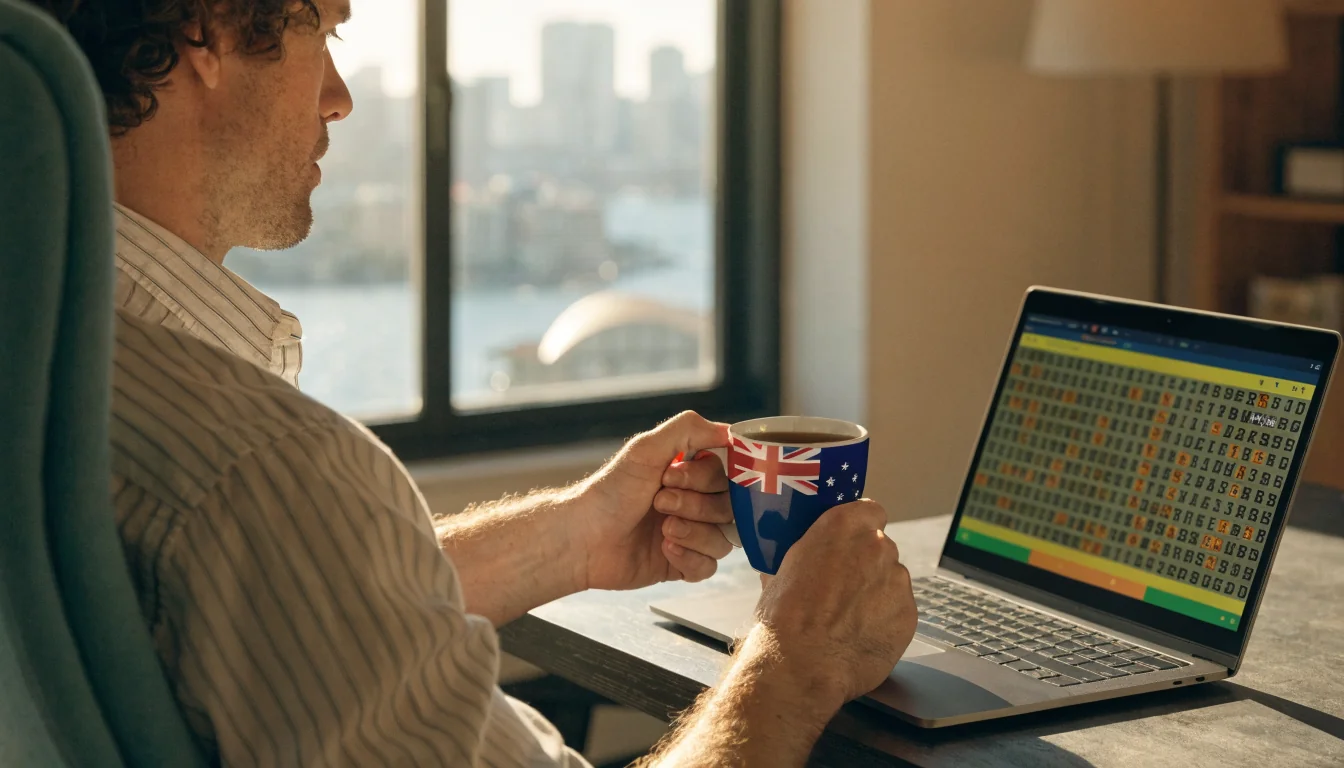
Bitcoin Blackjack: Possibilities and Restrictions for Australian Players
Bitcoin and other cryptocurrencies like Ethereum sometimes appear as payment options at offshore blackjack sites that accept Australian players. Before treating this as a convenience feature, it helps to understand where it sits legally.
The Interactive Gambling Act 2001 prohibits the provision of online casino games — including blackjack — to Australian residents. That prohibition applies to the operator regardless of which currency moves through the transaction. A site cannot make itself lawful by settling in Bitcoin instead of Australian dollars, and it cannot make itself unlawful that way either. The currency is a payment rail, not a legal status. What determines legality is the offshore operator’s licence and the fact that no domestic licence for online casino games exists at all.
Why crypto shows up on offshore platforms
Offshore operators use cryptocurrency largely because it moves across borders without relying on the same banking rails that traditional card payments use. For a player, this can translate into fewer failed transactions when a local bank flags an overseas gambling merchant. That is a practical observation about how the technology behaves, not a claim that it changes anything about the underlying legal position of the site.
It is not illegal for an individual Australian to play at an offshore-licensed casino — the law targets the businesses offering the games, not the person placing a bet. Using Bitcoin to fund an account does not alter that individual position, and it does not convert an unlicensed offshore operator into a licensed one.
What stays the same regardless of currency
Certain obligations apply to any operator serious about compliance, whether deposits arrive in fiat or crypto:
- Identity verification before withdrawal. Government-issued ID is still required to release funds, cryptocurrency or otherwise, to satisfy anti-money-laundering obligations.
- Age restriction. Access is limited to players 18 and over, with no exception for crypto-funded accounts.
- Wagering terms disclosed upfront. Any bonus tied to a crypto deposit still needs its conditions shown before the bonus is accepted, not buried afterward.
Where the uncertainty actually lies
The regulatory grey area is not whether Bitcoin transactions themselves are legal in Australia — they are, as a form of property and exchange. The uncertainty is about oversight: the Australian Communications and Media Authority can act against a gambling operator’s website by ordering it blocked, and it can refer matters to relevant authorities, but it has no mechanism to trace or recover cryptocurrency sent to an offshore operator, and no domestic authority licenses or supervises how these operators handle crypto wallets, reserves, or payout timing. There is no public registry to check any operator against, crypto-accepting or not, because no domestic licensing regime for online casino games exists to register them in.
This means a player choosing to fund a blackjack account with Bitcoin is relying entirely on the offshore operator’s own licence — commonly from a body such as the Malta Gaming Authority or the UK Gambling Commission — and on that regulator’s dispute processes, since no Australian body will mediate a crypto transaction dispute with an offshore casino. Whether that licence covers crypto transactions specifically, and how it enforces payout obligations, is something each operator’s own terms would need to state; it is not something published by any single authority covering the market as a whole.

Blackjack Strategy: Basic Tips for Reducing the House Edge
Blackjack is one of the few casino games where decisions you make at the table change the house edge, rather than leaving the outcome entirely to a random number generator. A basic strategy chart maps every hand you can be dealt against every card the croupier is showing, telling you whether the mathematically correct move is to hit, stand, double, or split. It doesn’t guarantee a win on any given hand, but applied consistently over many hands, it narrows the gap between your results and the payout table’s theoretical edge.
What a strategy chart actually does
The chart is built from the fixed probabilities of a card deck. Every combination of your two cards against the croupier’s up-card has one statistically best response, calculated from how the remaining cards are likely to fall. Using the chart means you’re not guessing whether to take a hit on a 16 against a dealer’s 7 — the math has already settled that question. Departing from the chart on a hunch, even a good-feeling one, moves your odds back toward the casino’s favour.

Where charts differ is in the rule set they assume: whether the croupier stands or hits on a soft 17, whether doubling after a split is allowed, how many decks are in play. A chart built for one rule set won’t give the same recommendations under another, which is why matching the chart to the table’s actual rules matters more than memorising a single version.
Bankroll management sits alongside strategy, not instead of it
Correct play only controls the house edge — it doesn’t remove variance. Over a short session, correct decisions can still lose money, and incorrect ones can still win. Bankroll management is the separate discipline of deciding, before you sit down, how much you’re willing to commit and what a stopping point looks like, win or lose. This is a planning decision made away from the table, not a reaction to how a shoe is running.
Gambling Help Online and BetStop both offer tools and support built around this kind of pre-commitment, including the option to set limits or exclude yourself from gambling activity entirely if you find those limits hard to hold to in the moment.
What strategy cannot do
No staking pattern — doubling bets after a loss, raising them after a win, or any other progression — changes the underlying probability of the next hand. Card counting, a separate technique built on tracking dealt cards to infer what remains in the shoe, is difficult to apply at live dealer tables where shuffling procedures and multiple decks are designed to limit its effect, and it carries no legal protection if a venue objects to its use.
A practical starting point
- Learn the chart that matches the specific rule variant on offer rather than a generic version.
- Treat doubling and splitting decisions as seriously as hit-or-stand ones — they carry more weight in the chart’s math.
- Set a session bankroll and a stopping point before play begins, not during it.
- Use the basic strategy chart as a reference during play rather than relying on memory alone, where the table format allows it.
Strategy reduces the house edge; it does not eliminate it or convert blackjack into a source of reliable income.
What to Look for When Choosing an Online Blackjack Platform
No domestic body issues licences for online blackjack in Australia, and no public register exists where you could look one up. That single fact changes how you have to evaluate a platform. You are not checking a local licence against a government list — you are checking what an offshore regulator has actually verified, and what the operator discloses on its own site.
Playing at an offshore-licensed casino is not illegal for you as an individual; Australian law targets the operators who offer these games, not the players who join them. That distinction matters because it means the responsibility for vetting a platform falls on you, not on a local authority checking it for you.
Licensing disclosure
Look at whether the operator states its licensing jurisdiction plainly, rather than burying it in a terms page or leaving it out altogether. A platform that names its regulator and licence details in the footer is giving you something to verify independently. One that avoids the topic is telling you something too.
The operator holds a licence from a foreign regulator such as the Malta Gaming Authority or the UK Gambling Commission; this is the only licence they can legally rely on.
The regulator monitors the operator’s compliance in its own jurisdiction, not in Australia, and provides dispute‑resolution mechanisms that are outside Australian law.
Because the licence is issued outside Australia, Australian authorities cannot enforce consumer‑protection rules or recover lost funds if the operator breaches its terms.
Identity and withdrawal checks
Any platform handling real-money blackjack should require identity verification before paying out withdrawals. This is standard anti-money-laundering practice, not an inconvenience specific to one operator. If a site pays out large sums without ever asking for ID, that is a warning sign, not a convenience.
Payment methods
Check what a platform accepts and, more importantly, what it refuses. Deposits and betting through credit cards or digital currencies should not be on offer — a platform still allowing either is out of step with how compliant sites operate elsewhere. What remains — bank transfers, e-wallets, and similar methods — should have processing behaviour explained clearly, not left vague.
Responsible-gambling tools
A legitimate platform gives you the ability to set your own bankroll and time limits before you need them, not after. Look for these controls in the account settings, not just mentioned in a help article. Advertising and promotional material should carry harm-reduction messaging as a matter of course, without the topic being treated lightly or brushed aside as a formality.
Bonus terms
If a platform advertises a bonus, the wagering requirements attached to it should be visible before you accept the offer — not revealed once you try to withdraw. A platform that discloses these terms up front is behaving the way a compliant operator should; one that hides them until after deposit is not.
Complaints and support
Check for a visible complaints process and membership in an alternative dispute resolution scheme. This is separate from land-based casino oversight, which sits with state regulators and law enforcement — offshore platforms answer to nobody in that structure, so their own complaint channel is the only recourse you have if something goes wrong.
None of these checks guarantee an outcome. They tell you whether the operator is built to withstand scrutiny, which is the most concrete thing you can assess before depositing money.

Understanding the Blackjack Switch Variation and Winning Tips
Blackjack Switch changes the structure of the game itself, not just the betting options around it. You play two hands side by side, each with an equal wager, and after the first two cards land on both, you get the choice to swap the second card of one hand with the second card of the other. That single move is the whole point of the variant: it lets you turn two mediocre starting hands into one strong hand and one weak hand, rather than leaving both mediocre.
The trade-off is built into the payout structure. A player blackjack in this variant pays even money rather than the enhanced payout you’d see in standard blackjack, because the switch option gives you an edge the house has to claw back somewhere. There’s also a rule specific to this variant covering what happens when the dealer’s hand totals 22 — it typically results in a push against player hands that would otherwise have won, rather than a dealer win, which further offsets the advantage of switching cards.

How the switch changes your decisions
Because you’re managing two hands at once, the decisions you make on one hand affect what’s worth doing on the other. If the first hand ends up with a strong total after the switch, the second hand often becomes the one you’re willing to risk more on, since the pair is judged as a package rather than two separate bets in your head — even though they’re settled independently.
Practical tips for playing it
- Look at both starting hands together before deciding whether to switch, rather than evaluating each in isolation — the value of a swap depends on what you’d be left with on both sides.
- Remember the even-money payout on blackjack changes the math compared to standard tables, so treat basic strategy charts for regular blackjack as a starting point only, not a direct fit.
- Factor in the dealer 22 push rule when deciding how hard to play borderline hands, since it removes some of the risk you’d normally weigh against the dealer’s upcard.
- Treat the two wagers as a single bankroll decision, since you’re committing double the stake per round compared to a single hand of standard blackjack.
The variant rewards players who think in terms of two hands working together rather than two independent bets placed at the same time.
Popular Blackjack Variants You May Encounter Online
Standard blackjack is not the only version you will find on offshore casino sites. Software providers build several rule variations on the same basic structure, and each one changes the odds or the flow of the game slightly. Knowing the differences helps you avoid confusion mid-hand rather than working out the payout structure after you have already placed a bet.
European Blackjack deals the dealer only one card face up, with the second card added after players act. This changes basic strategy slightly compared to versions where the dealer’s hole card is dealt immediately.
Spanish 21 removes all 10-value cards from the deck, keeping face cards and aces. In exchange, it typically offers more favourable payout rules and player options than a standard deck game, which shifts the house edge in a different direction than you might expect from a deck missing tens.
Multi-hand blackjack lets one player control several hands at once during the same round, rather than sharing a table with other players. It suits anyone who wants to play faster or test more hands per session without waiting for others to act.
Progressive blackjack links a side bet to a jackpot pool, separate from the main hand outcome. The core blackjack rules stay the same; only the optional side wager changes.
Blackjack Switch, covered separately, belongs in this same family of variants but is distinct enough in mechanics to warrant its own explanation.

Not every offshore operator carries all of these variants, and rule details for each — like specific payout ratios or deck counts — vary by provider such as Pragmatic Play, Microgaming, NetEnt, or Evolution Gaming. Checking the game’s information panel before betting is the only reliable way to confirm which rules apply at that specific table.
Official Blackjack Rules Applicable to Australian Players
Blackjack itself is governed by a stable set of internationally recognised rules: the goal is to beat the dealer’s hand without exceeding 21, cards carry fixed values, and specific outcomes (like a natural blackjack) trigger set payouts. These mechanics don’t change depending on where a player is located, and no Australian body writes or certifies its own version of the game’s rules.
What does differ, by jurisdiction, is whether a platform offering these rules to Australian players is doing so legally. Under the Interactive Gambling Act 2001, online casino style games — including blackjack, slots, poker, and roulette — are prohibited at the federal level, along with in-play betting. This prohibition sits at the level of the operator, not the rulebook: the law targets who can offer the game to Australian residents, not how the game itself is played.
That distinction matters when reading about "official" blackjack rules online. A ruleset described as standard or licensed refers to game design, not to the legal status of the site presenting it. No Australian regulator issues a domestic licence for this kind of game, so the rules you encounter are set by the platform’s own terms, wherever it happens to be based.
What are the best online casinos in Australia for 2026?
There are no domestically licensed real-money online casinos available to Australian players, as the Interactive Gambling Act 2001 prohibits operators from offering online blackjack and other casino games domestically. Australians can only access offshore-licensed platforms, such as those regulated by the Malta Gaming Authority or the UK Gambling Commission, since playing at these sites is not criminalised for the individual.
How can a player verify that an online casino holds a valid licence in Australia?
You cannot verify this, because no Australian licensing pathway exists for online casinos. Any site claiming an Australian gambling licence for online casino games is misrepresenting its status.
Where can I complain about an online casino in Australia?
You cannot turn to Australian authorities to settle disputes with offshore operators. While ACMA enforces the Interactive Gambling Act 2001 and blocks illegal sites, it has no power to recover your funds or resolve individual disputes.
Are crypto casinos legal in Australia in 2026?
The Interactive Gambling Act 2001 prohibits operators from offering online casino-style games to people in Australia, regardless of whether they use crypto or fiat currency. However, it is not illegal for you as an individual to play at offshore-licensed platforms.